New: GPT Image 2.5 Flare and Sunburst. Try them free with 3 images on sign-up, then 8 credits each.
Try GPT Image 2.5

Traditional portraits AI prompts

35 templates · Nano Banana 2.1, Nano Banana Pro · updated Oct 2026

These prompts generate portraits featuring regional heritage wear, ceremonial bridal attire, and historical garments. Customize templates by specifying textile fabrics, embroidery motifs, and architectural settings like courtyards or palaces while keeping subject identities intact.

Sort by:

Showing 1–35 of 35 prompts

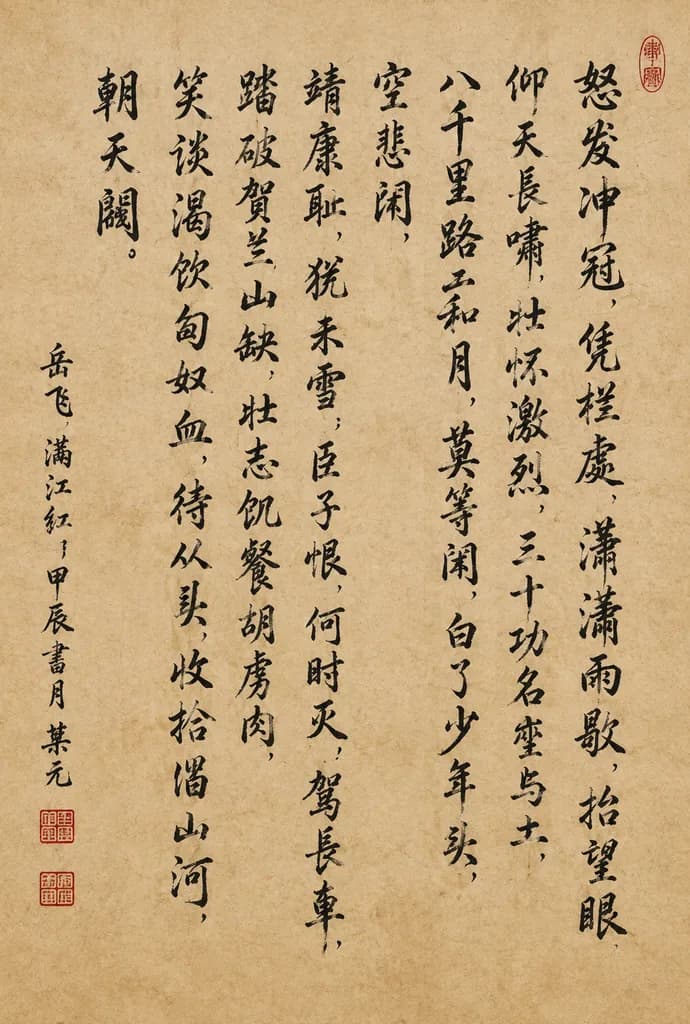
Chinese Cursive Calligraphy Scroll

Chinese Cursive Calligraphy Scroll

A clean flat photograph scan of an unframed traditional Chinese calligraphy hanging scroll on aged beige xuan paper. The composition consists entirely of vertical Chinese cursive script (caoshu), executed in bold, expressive deep black ink with flying-white dry brush textures, natural stroke variation, and an energetic rhythm. The main poem text is written in vertical columns arranged from right to left across approximately eight main columns: "[怒发冲冠,凭栏处、潇潇雨歇。抬望眼,仰天长啸,壮怀激烈。三十功名尘与土,八千里路云和月。莫等闲,白了少年头,空悲切。 靖康耻,犹未雪;臣子恨,何时灭!驾长车,踏破贺兰山缺。壮志饥餐胡虏肉,笑谈渴饮匈奴血。待从头,收拾旧山河,朝天阙。]" On the left margin, a smaller inscription in three narrow columns reads: "[岳飞 满江红 甲辰書月 某元]" in a more restrained cursive hand. Exactly three red seal stamps accent the piece: one small oval seal at the top-right corner beside the opening line, and two vertically stacked square red seals in the lower-left margin beneath the inscription. The xuan paper exhibits visible fiber textures, subtle tan mottling, and delicate antique patina with an authentic museum-grade Song dynasty aesthetic.

calligraphychinese artink wash
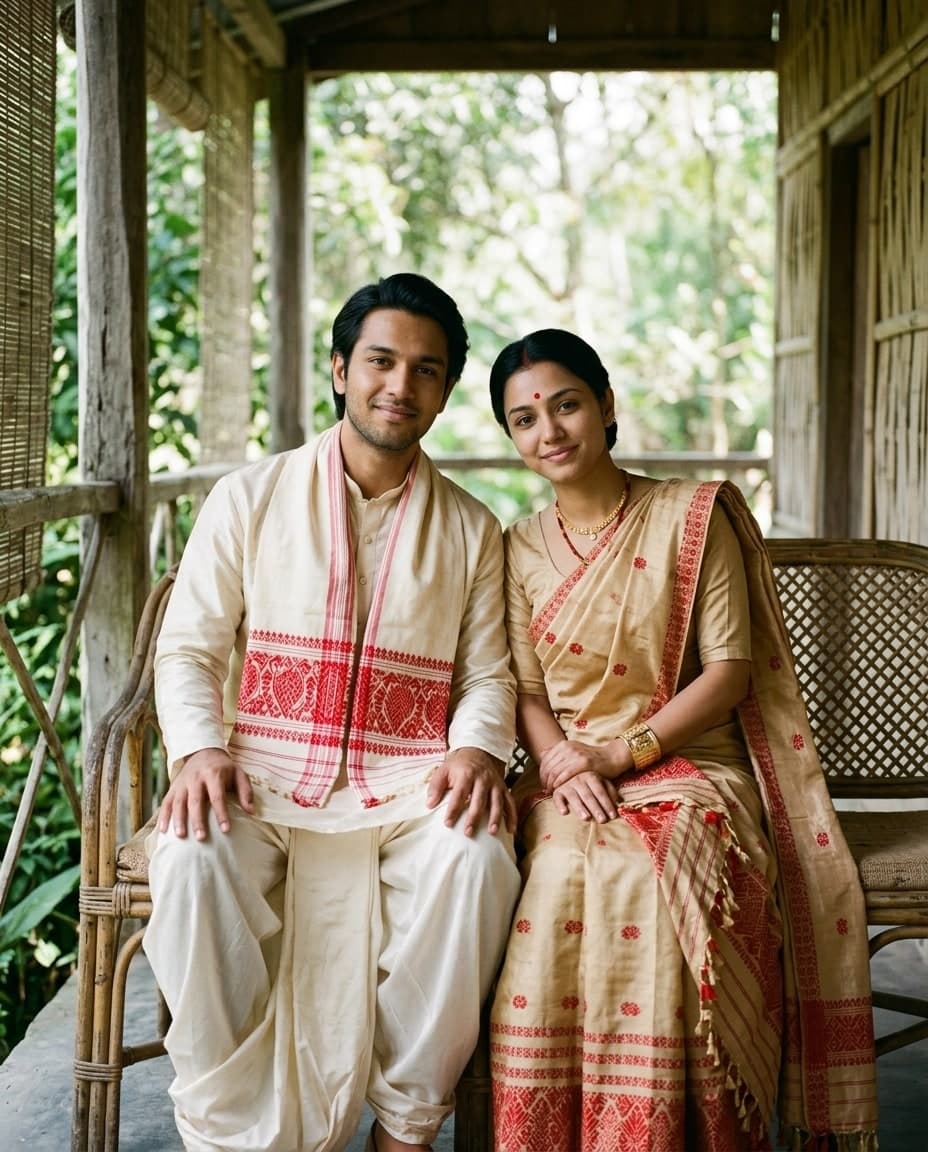
Assamese Muga WeddingNew

Assamese Muga Wedding

Create a photorealistic wedding portrait of exactly the two adults in the reference images. Image 1 is the man and image 2 is the woman. Use these photographs as the only identity references. Preserve both recognizable facial identities, natural skin tones, face shapes, eyes, noses, mouths, hairlines, facial hair, apparent ages and body proportions. Keep the man on the left and the woman on the right. They remain the same Indian individuals, with natural skin texture and believable gentle bridal grooming; no skin lightening, face replacement, de-aging or generic model faces. Replace their casual clothing with the specific attire below. Give them natural, comfortable body language, clear unobstructed faces and anatomically plausible hands. Make a vertical 4:5 medium portrait, approximately mid-thigh or waist upward, with sufficient space above both heads and around the shoulders for later cropping. Both faces should be turned toward the camera and recognizable. Use realistic wedding photography, coherent natural light, real fabric and jewellery textures, softly separated background and lifelike expressions. One photographic image with exactly two main people, no split-screen, illustration, text, watermark or decorative photo border. Avoid a Western wedding gown, tuxedo, church or champagne props. Regional character must come from the garments, textiles, jewellery and setting, never from replacing either face with a stereotyped regional face. Preserve any original facial hair, natural body build and mature features. Keep both people individually recognizable, with comfortable asymmetrical posture rather than rigid mannequin poses. Specific wedding look and scene: An Assam-inspired wedding portrait in a quiet bamboo-and-wood veranda near lush green trees. The bride wears a warm champagne-gold muga-silk mekhela chador with restrained red woven motifs, a matching modest blouse and a few elegant Assamese-inspired gold ornaments. Preserve her natural hair texture and face; use a neat low hair arrangement and a small bindi. The groom wears an ivory silk kurta with dhoti-style trousers and a cream handwoven cheleng chadar with red woven accents. They sit close on a simple cane bench, leaning gently toward each other, hands relaxed on their own laps and faces turned toward the camera. The warm lustre of muga silk, handwoven texture and soft greenery are central. Do not change their facial features or skin tones to imitate a regional stereotype.

weddingassamesemuga silk
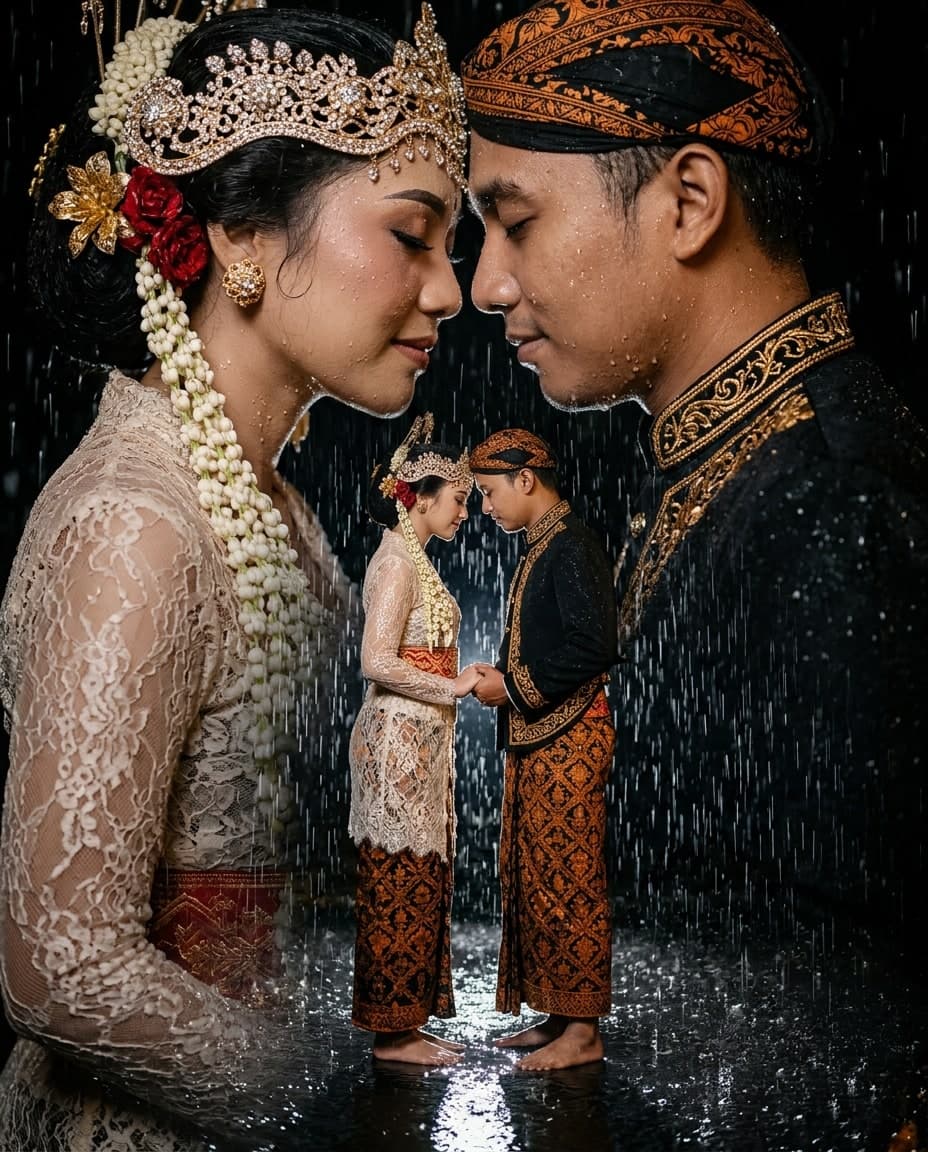
Rainwoven VowsNew

Rainwoven Vows

Vertical double-layer overlay composite composition of a traditional wedding photo on a rainy night, the whole frame filled with dense, vertically falling transparent raindrops; the people's skin, hair strands and clothing surfaces are covered with plump, translucent water droplets with specular highlight refraction; the overall background is plain, dark, minimalist pure black. The left and right sides of the frame are enlarged close-up face shots of the two people, foreheads pressed tightly together, both with eyes closed and a gentle, peaceful expression; the woman wears a gorgeous crystal and gilded headdress, gold gemstone carved earrings by her ears, a white strand-style floral garland wrapped around her neck and shoulders, and a light apricot, richly crafted lace-embroidered traditional top; the man wears a black-based head wrap with orange-gold retro patterns, and a black traditional stand-collar top with gold-trimmed embroidery; the center of the frame is a full-body real-scene portrait of the couple, standing barefoot on a bright, wet, water-covered ground, the water surface reflecting fine fragments of light and shadow, the two facing each other with hands tightly clasped and heads leaning slightly together; the woman's hair is in an updo with gold flowers and red accent flowers and the same gilded headdress, wearing an off-white sheer lace long-sleeved top, paired with a wide red-and-gold waist sash and a black-and-orange retro-print long traditional skirt; the man wears a head wrap of the same pattern, a black-and-gold trimmed embroidered top and an orange-and-black wrap-style lower garment with the same pattern; the overall approach uses directional soft light to selectively brighten the people, the dark background maximizing the warm brown, off-white and red-gold clothing tones of the people, with the lace cut-out textures, brocade print patterns, translucent raindrops and puddle reflections all rendered in realistic, fine detail, a solemn, tranquil rainy-night traditional wedding atmosphere, hyper-realistic wedding portrait photography, 8K high-definition sharp image quality, no watermark, no play icon, no extra clutter, the people's limb structures natural and free of deformities.

weddingraincouple
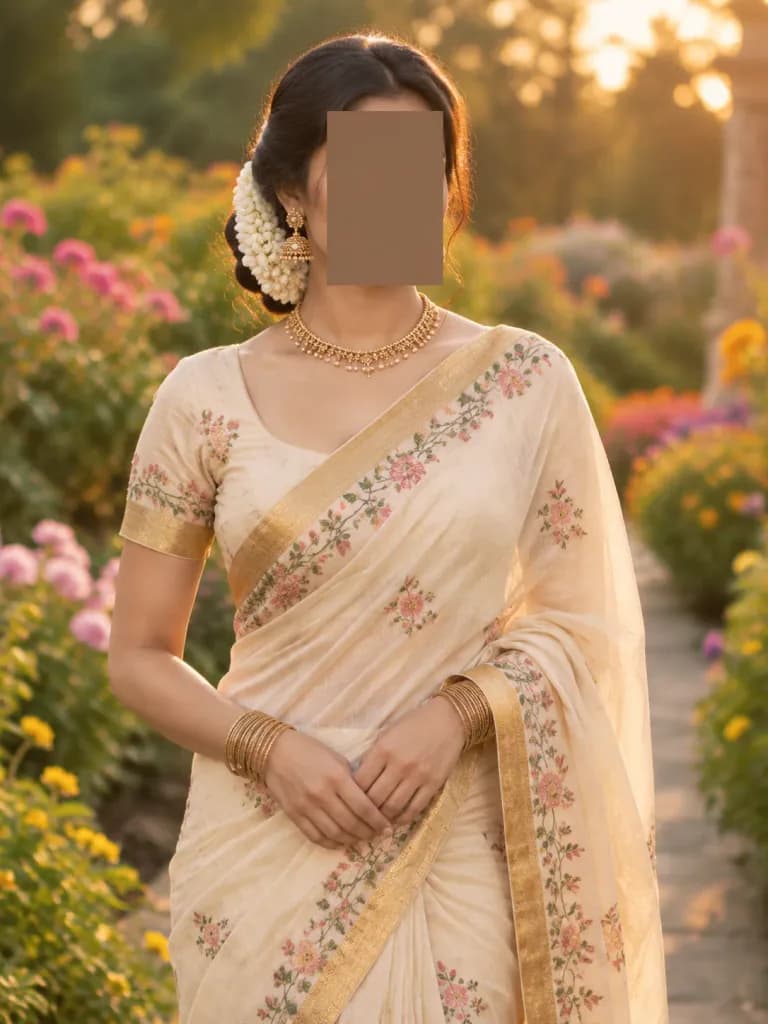
Golden Hour Saree Garden Portrait

Golden Hour Saree Garden Portrait

Professional portrait photograph of a young [Indian] woman standing in a lush blooming garden during golden hour, framed vertically from mid-thigh upward. She wears a classic [cream-colored] saree with elegant gold borders and delicate pink-and-green floral embroidery, paired with a matching short-sleeved blouse. Her dark hair is styled in a low bun adorned with a thick garland of fresh white jasmine flowers on one side. She wears traditional gold jewelry: a necklace, ornate dangling earrings, and stacked slim bangles on both wrists. Her hands rest gently clasped at her waist. A plain, solid medium-brown rectangular privacy censor block covers her entire face from forehead to chin, leaving no facial features visible. Background features a softly blurred garden path with vibrant flowers in pink, orange, yellow, and purple, with warm sunset bokeh. Soft natural lighting, shallow depth of field, refined editorial fashion photography aesthetic.

sareeportraitgolden hour
Ivory EchoNew

Ivory Echo

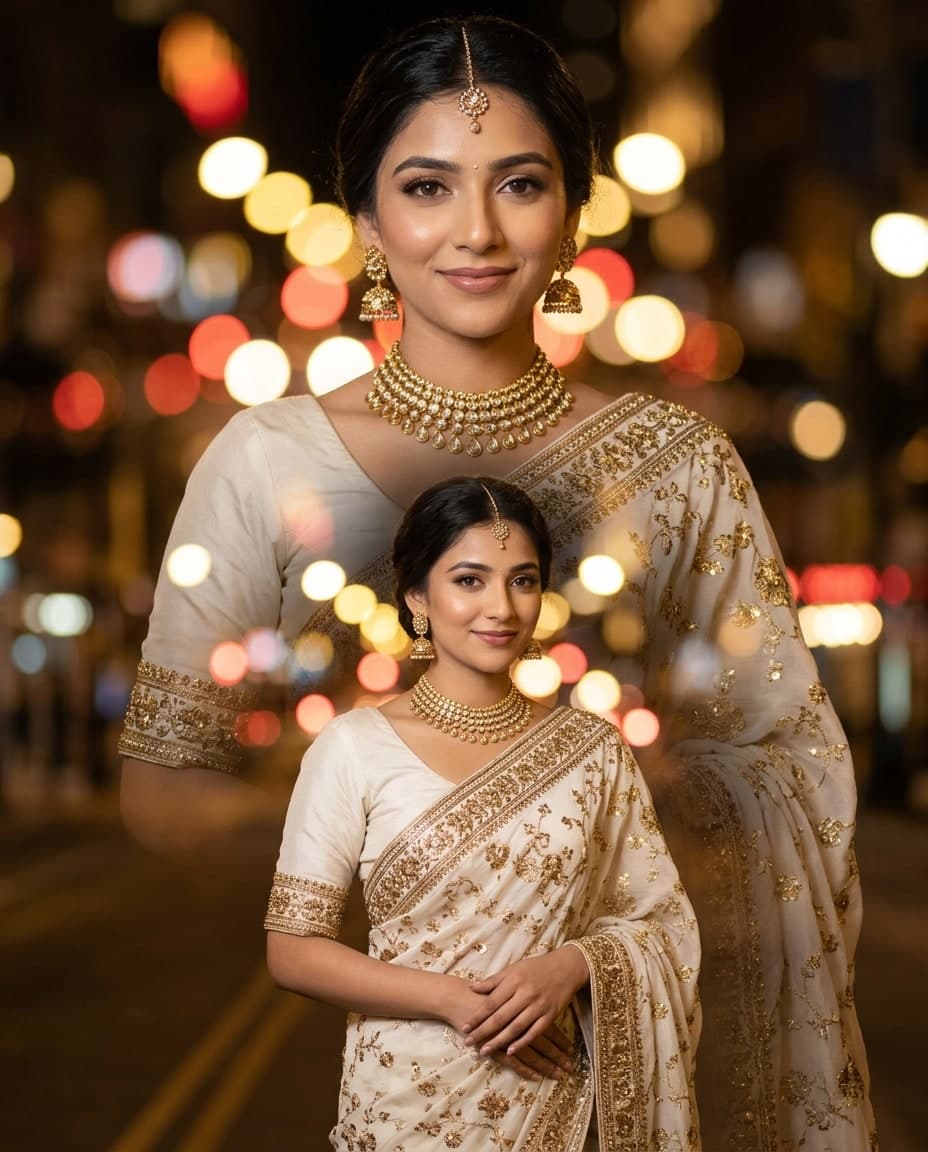
A double-exposure composite with two semi-transparent layers. The upper layer is a semi-transparent close-up bust shot of the woman facing forward; the lower layer is a medium half-body shot of her slightly turned. Both layers share identical hairstyle, makeup, jewelry, and clothing. The lower figure stands in the lower half of the frame, facing the camera with a gentle smile, hands clasped softly in front, wearing a matte ivory saree adorned with intricate gold floral embroidery and heavy beaded borders. The upper overlaid layer mirrors the woman smiling gently at the camera. She wears ornate South Asian gold jewelry, including a multi-tiered teardrop choker and double-tier Jhumka earrings, complemented by elegant, luminous makeup. The background is a night city street with soft warm yellow and red circular bokeh lights. Soft warm side lighting, luminous skin texture, and a gentle ivory-gold color palette, rendered in 8K ultra-realistic night portrait photography.

double exposuresareeportrait photography
Indian WeddingNew

Indian Wedding

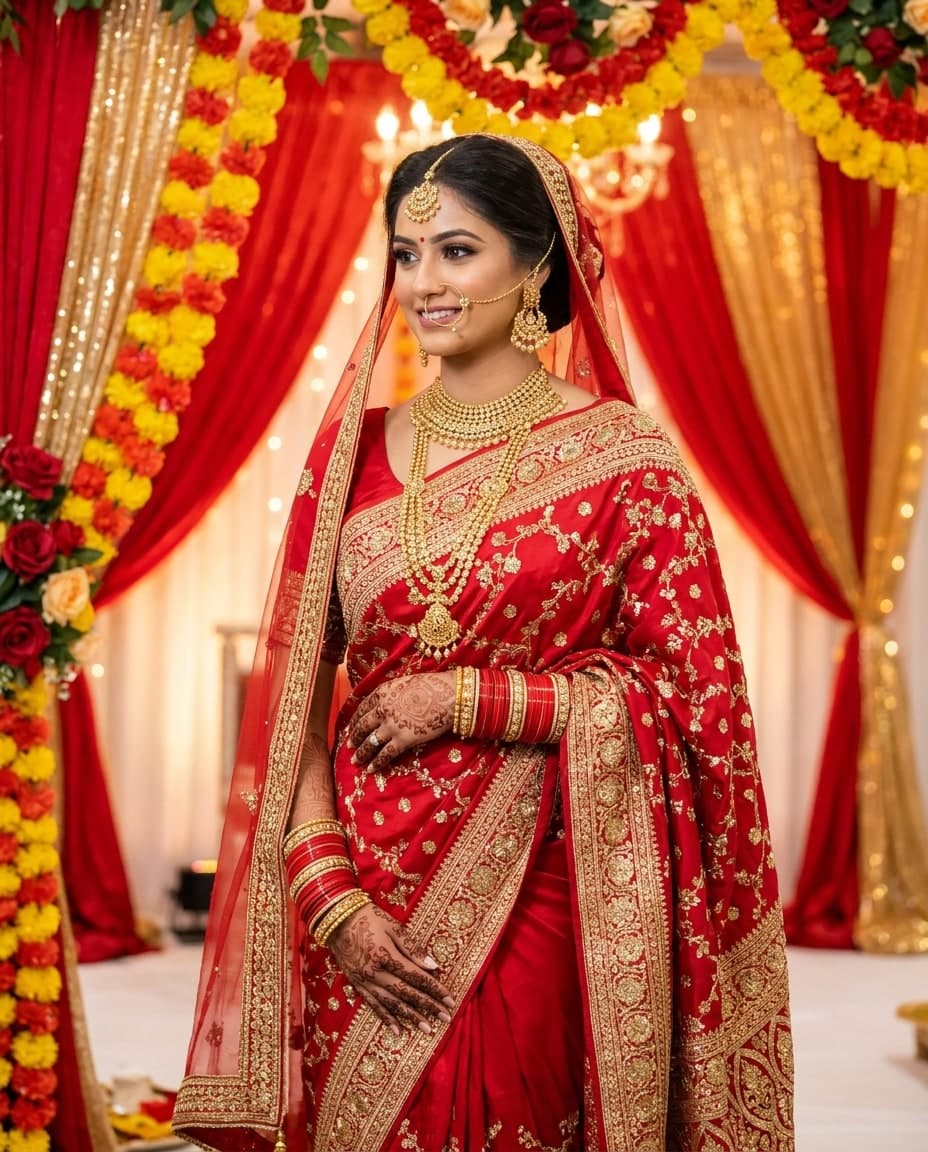
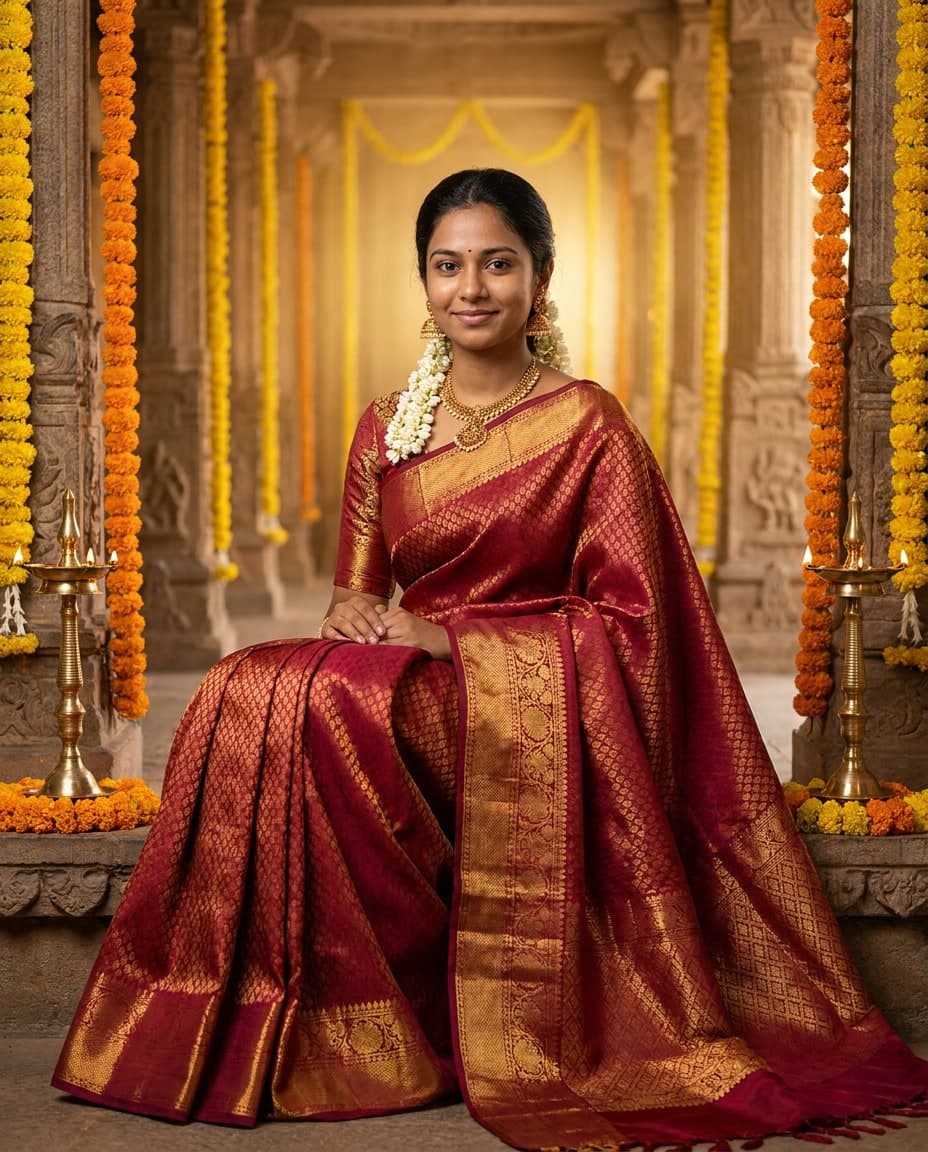
High quality, real, HDR, HD, Indian wedding dress in red color, designed in Indian sari style wedding dress. The material is usually silk or cotton, and decorated with gold thread or jewelry

indian weddingred saribridal
Ottoman HeritageNew

Ottoman Heritage

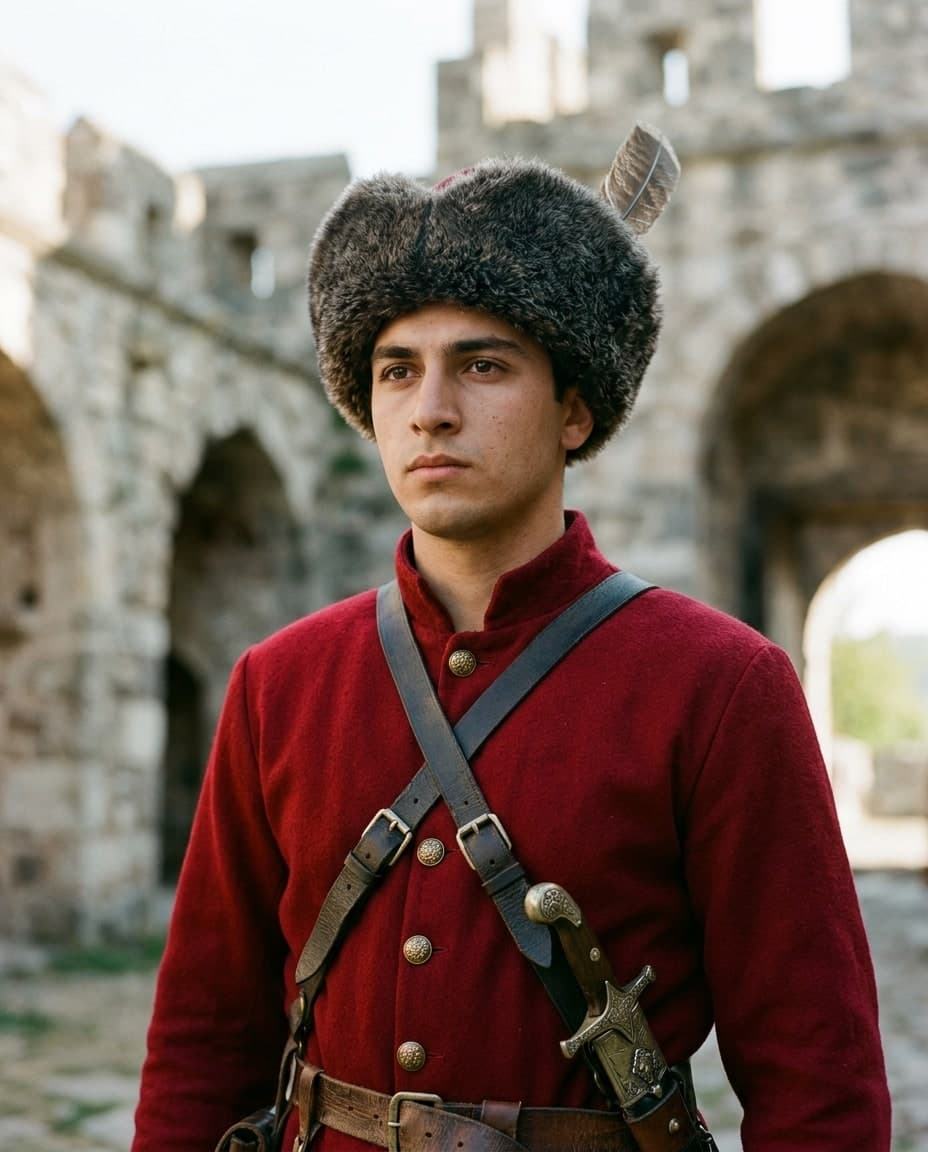
Close-up, upper body shot,1 Turkey, A young man in historical military attire, featuring a deep red tunic with brass buttons and cross straps,wears a large, round, fur-lined hat adorned with a feather,belt includes a sword sheath, adding to the militaristic appearance,The background includes an ancient stone architecture, suggesting a historical or cultural setting,giving a sense of an ancient or historical setting,expression is serious and focused, with soft lighting highlighting the traditional and formal nature of his uniform.

ottomanhistoricalmilitary portrait
Ming Dynasty Hanfu Wedding Portrait

Ming Dynasty Hanfu Wedding Portrait

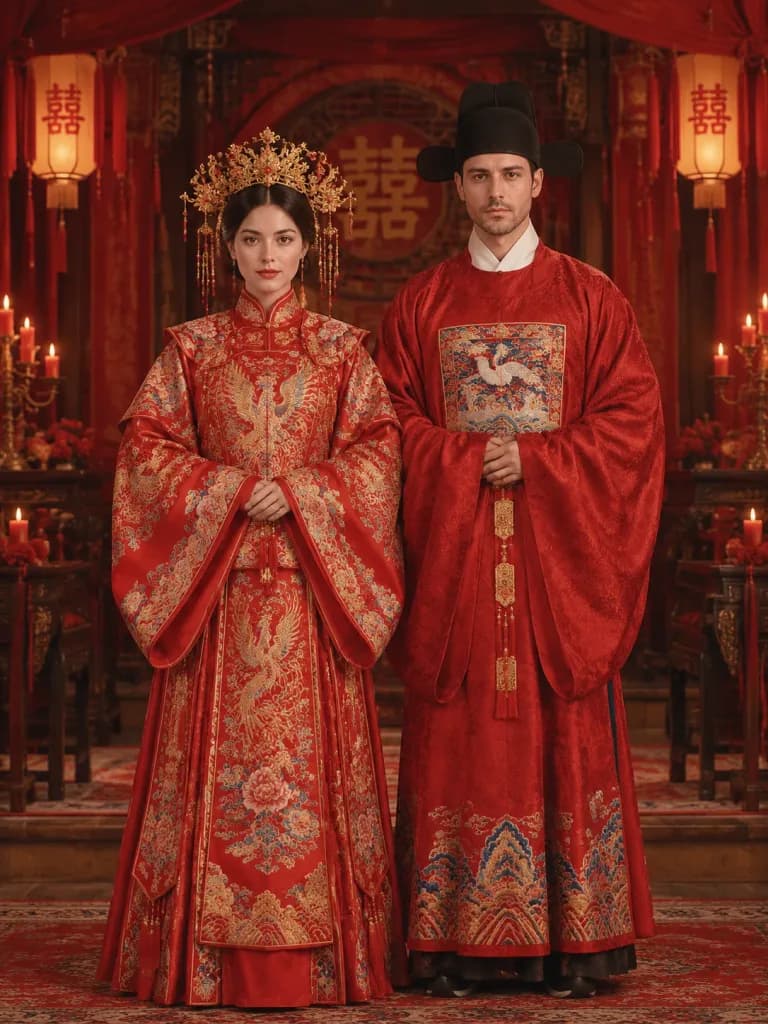
High-end, realistic Ming Dynasty style wedding photograph based on the reference photo of the couple. Maintain their exact facial identity features, face shapes, feature proportions, eyes, nose, lips, natural skin tone, age, temperament, and height difference, avoiding over-smoothing, AI artifacts, or facial swapping. Subjects and Attire: - Bride: Bright red Ming-style wedding attire including an intricate gold-woven large-sleeved shirt and jacket-skirt with embroidered phoenix, peony, and auspicious cloud patterns. Wears an ornate gold Phoenix crown (Fengguan), classic centered low bun hairstyle, and dignified classical makeup with refined red lips. - Groom: Bright red round-collar Ming robe with an embroidered rank patch, paired with a black gauze official cap (Wusha hat), presenting an upright, scholarly, and dignified appearance. - Attire consistency: Exact red-and-gold color palette, embroidery patterns, and traditional fabric textures. Setting and Lighting: Ancient Ming-style architectural interior or luxury traditional hall decorated with deep red drapery, dark carved Ming-dynasty wooden furniture, hanging palace lanterns, and subtle 'Double Happiness' symbols. Cinematic, warm red-and-gold ambient lighting accented by soft candlelight glow. Composition and Scene: [Full-body main ceremony poster shot: the couple stands upright in the center facing the camera with solemn, dignified expressions, exuding magnificent ceremonial presence].

hanfuwedding portraitming dynasty
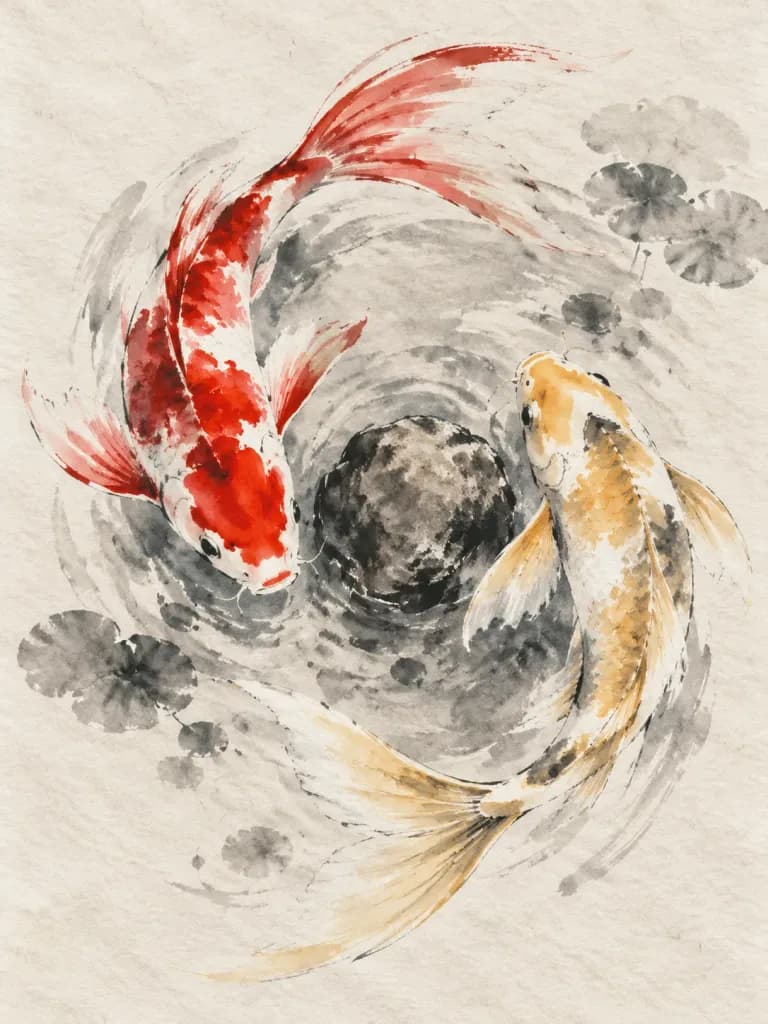
Sumi-e Koi Fish Ink Wash Painting

Sumi-e Koi Fish Ink Wash Painting

A traditional Japanese ink wash painting of [a pair of graceful koi fish] circling [a submerged stone]. Expressive sumi-e style with fluid black ink brushwork and delicate [crimson and pale gold] watercolor tints. Pigments softly bleed into [fibrous textured rice paper], creating a serene, minimalist atmosphere with negative space.

sumi-eink washkoi fish
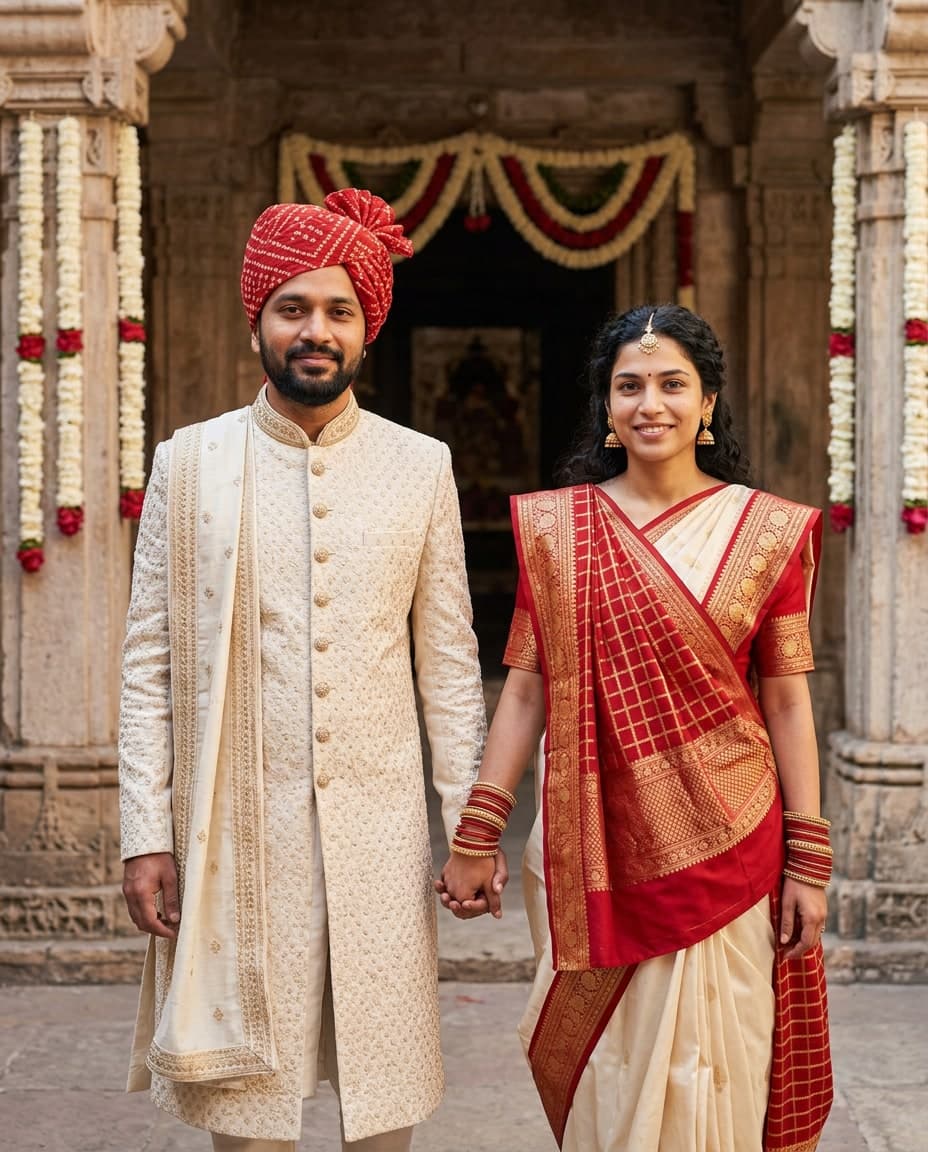
Gujarati Panetar WeddingNew

Gujarati Panetar Wedding

Create a photorealistic wedding portrait of exactly the two adults in the reference images. Image 1 is the man and image 2 is the woman. Use these photographs as the only identity references. Preserve both recognizable facial identities, natural skin tones, face shapes, eyes, noses, mouths, hairlines, facial hair, apparent ages and body proportions. Keep the man on the left and the woman on the right. They remain the same Indian individuals, with natural skin texture and believable gentle bridal grooming; no skin lightening, face replacement, de-aging or generic model faces. Replace their casual clothing with the specific attire below. Give them natural, comfortable body language, clear unobstructed faces and anatomically plausible hands. Make a vertical 4:5 medium portrait, approximately mid-thigh or waist upward, with sufficient space above both heads and around the shoulders for later cropping. Both faces should be turned toward the camera and recognizable. Use realistic wedding photography, coherent natural light, real fabric and jewellery textures, softly separated background and lifelike expressions. One photographic image with exactly two main people, no split-screen, illustration, text, watermark or decorative photo border. Avoid a Western wedding gown, tuxedo, church or champagne props. Regional character must come from the garments, textiles, jewellery and setting, never from replacing either face with a stereotyped regional face. Preserve any original facial hair, natural body build and mature features. Keep both people individually recognizable, with comfortable asymmetrical posture rather than rigid mannequin poses. Specific wedding look and scene: A Gujarati wedding portrait centred on a red-and-ivory panetar sari. The bride wears an ivory silk sari with a broad red border, a red blouse and a red gharchola-style ceremonial drape with a clear woven gold grid pattern. Add refined gold earrings, a small maang tikka and red-gold bangles; the drape must not cover her face. The groom wears a cream embroidered sherwani, a red bandhani safa and an ivory stole. They pause while walking side by side through a sunlit carved Gujarati courtyard, hands loosely joined low between them and both glancing toward the camera with happy, natural expressions. Ivory-and-red floral mandap decorations and a traditional carved doorway provide context, without filling the frame with unrelated religious props. Make the sari folds and the gharchola grid visibly different from a generic lehenga.

weddinggujaratipanetar sari
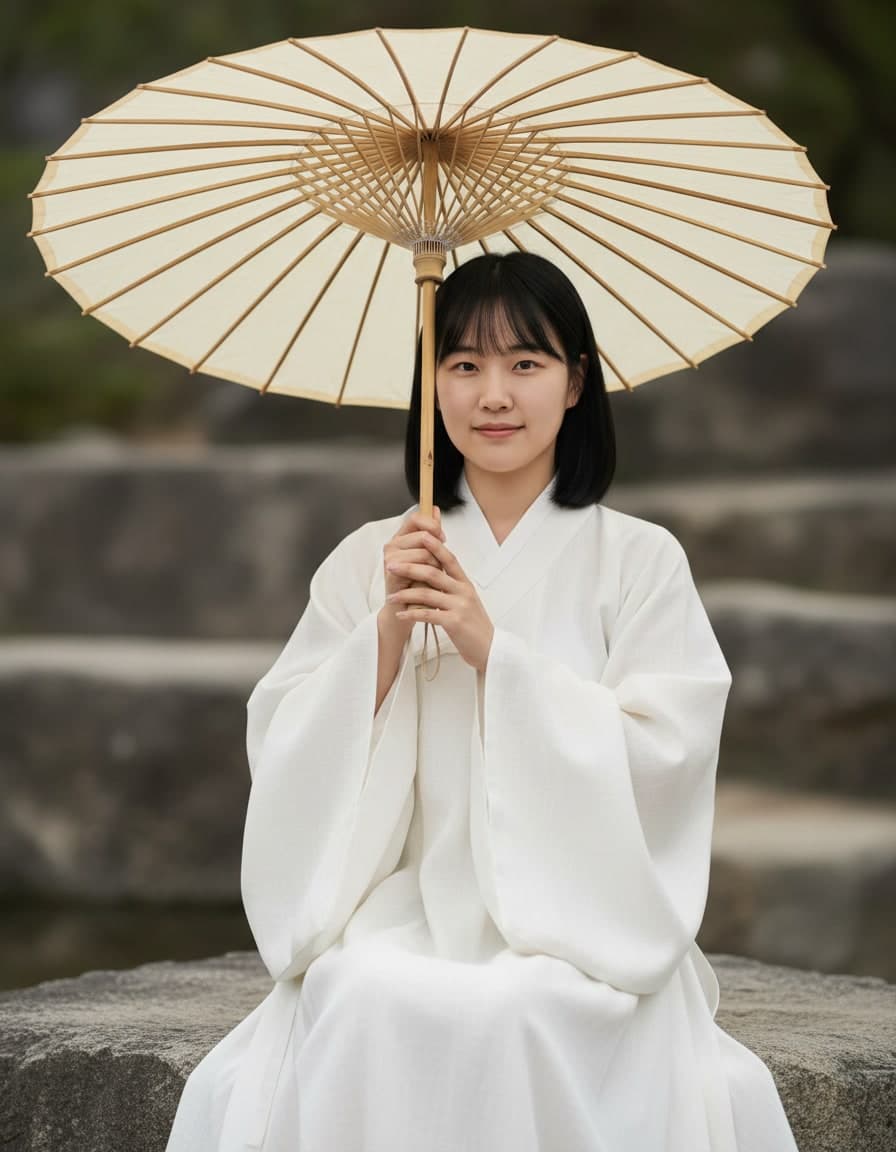
White HanfuNew

White Hanfu

The subject is dressed in an elegant, traditional white Hanfu robe crafted from soft, textured linen, featuring a classic cross-collar neckline and voluminous wide sleeves that drape heavily around the forearms, with the skirt fabric gathe…

hanfuoil-paper umbrellatraditional
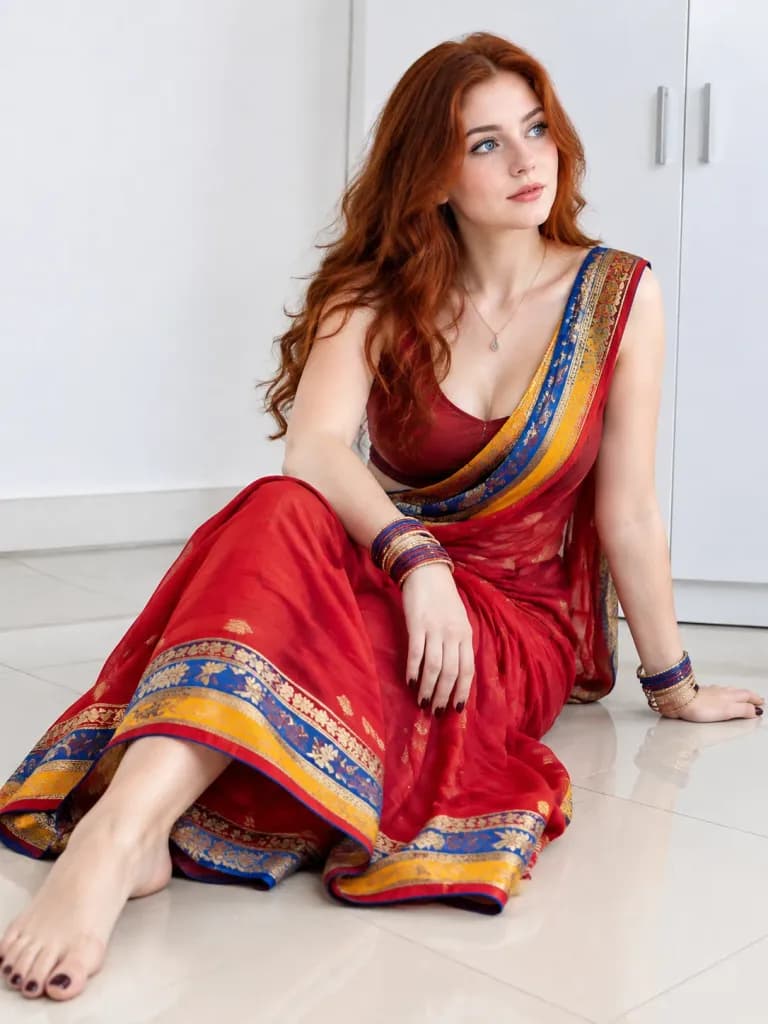
Young Woman in Red Saree

Young Woman in Red Saree

A realistic indoor portrait of a [beautiful young woman] with fair skin, striking blue eyes, and long, voluminous wavy red hair cascading down her back and over one shoulder, seated gracefully on a light-colored tiled floor. She is wearing a [traditional saree in vibrant red with blue, yellow, and golden border patterns], draped elegantly with a matching red sleeveless blouse. Adorned with a delicate necklace, colorful bangles on both wrists, and dark nail polish on her fingers and toes. Relaxed, artistic pose with one leg extended, one bent, one hand resting on her knee, and the other supporting her on the floor. She gazes thoughtfully to the side with a serene expression. The [background features plain white walls and a tall white cabinet with handles]. Bright, even lighting creating clean modern ambiance with soft shadows.

sareeportraitwoman
Anarkali GraceNew

Anarkali Grace

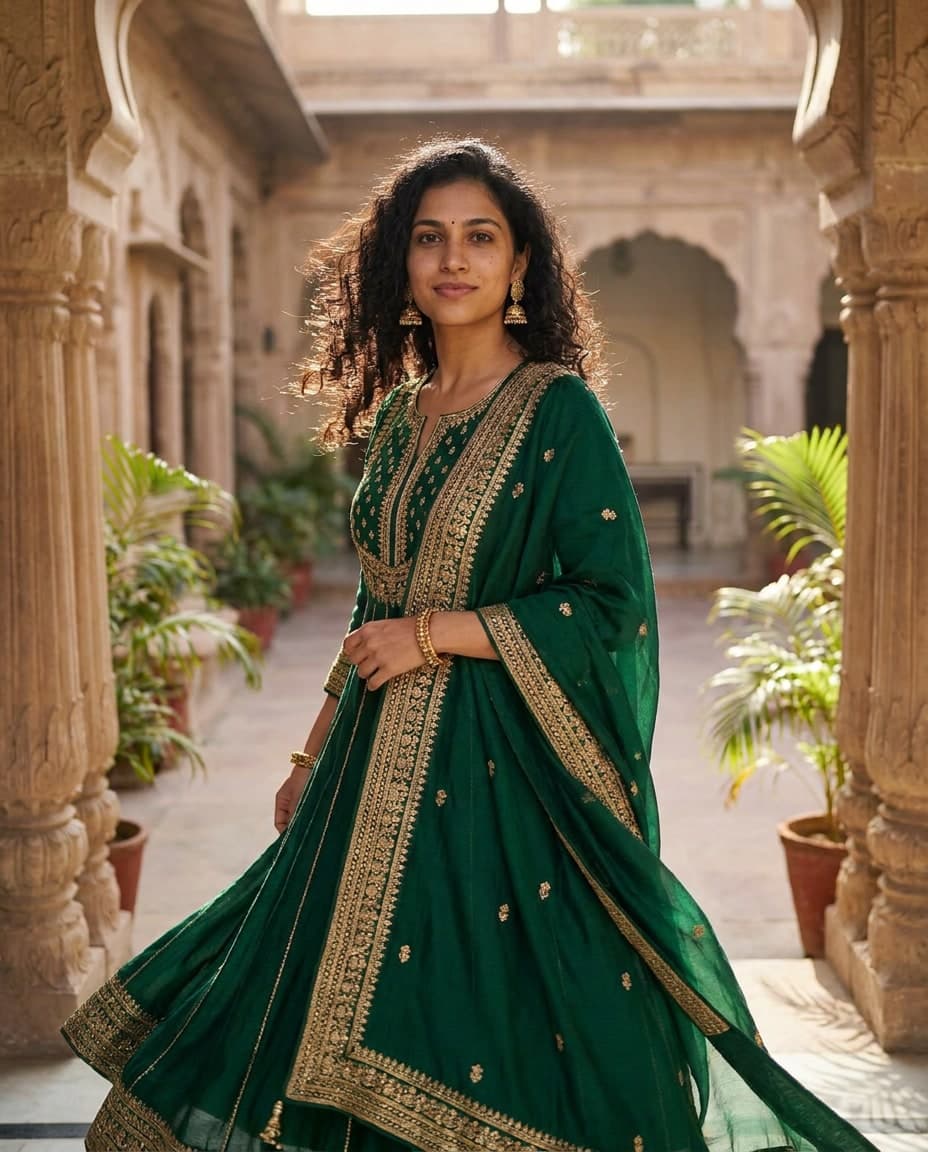
Use the uploaded selfie as the only identity reference. Create a highly realistic portrait of the same person wearing a graceful traditional Anarkali outfit. The person should wear a flowing Anarkali dress with elegant embroidery, a matching dupatta, refined jewelry, and a poised portrait pose. The outfit should feel graceful, festive, and timeless. Use a beautiful cultural background such as an old haveli, palace archway, decorated courtyard, or warm festive interior. Preserve the person’s recognizable facial identity and overall appearance from the uploaded selfie. Do not specify or change hair color, skin tone, ethnicity, or race. Emphasize flowing fabric, elegant movement, detailed embroidery, soft lighting, natural facial detail, and premium fashion photography quality. Style: photorealistic Anarkali fashion portrait, Indian traditional elegance, flowing fabric, festive heritage background, soft cinematic lighting, high detail.

anarkaliindian fashiontraditional
Mirror Palace SplendorNew

Mirror Palace Splendor

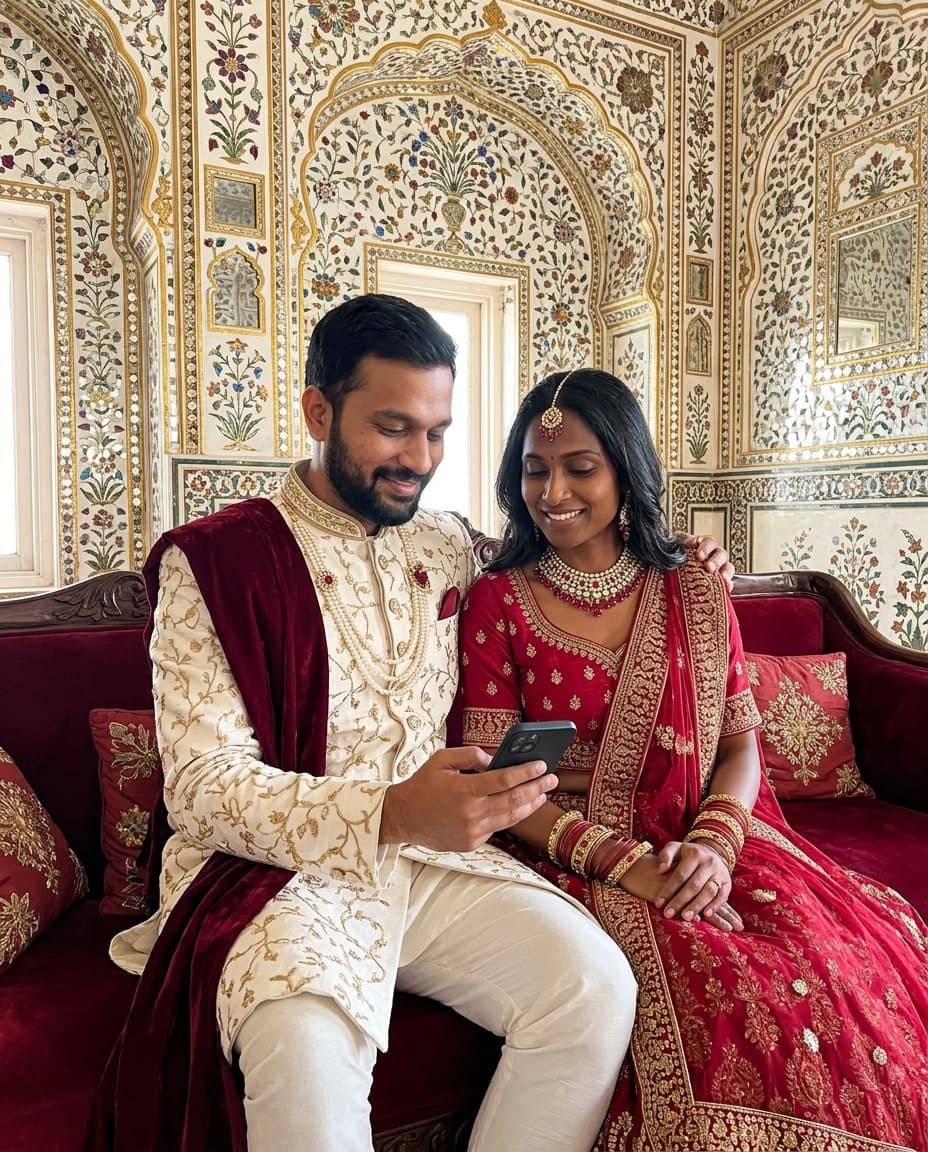
Using the same adult man from reference photo 1 and the same adult woman from reference photo 2, generate a couple's photo in a lavish Indian royal style. Strictly preserve each person's original facial feature proportions, face shape, true skin tone, age, hairline, hairstyle, beard, glasses status and body type; do not swap or blend faces; do not whiten skin, slim the body or make anyone look younger. Change only the clothing, jewelry, pose and environment. The people's appearance is based only on these two original photos; the palace scene and identities are original fiction. Both faces must be clear, unobstructed, and naturally looking at the camera. Scene: the inner hall of a Rajasthan-style Indian Mirror Palace, with walls densely inlaid with mirrors, colored-glass flowers and fine golden arched niches; a deep red carved velvet sofa takes up the lower part of the frame, and the mirrors show only tiny scattered points of light and produce no additional complete figures. Natural light from a side window in the room illuminates the faces, and the mirrors and real gold thread give fine, scattered reflections. Clothing: the man wears an ivory long sherwani embroidered with gold-thread vines, a deep wine-red velvet shawl over his shoulders, a three-strand small pearl necklace and a ruby brooch; the woman wears a pomegranate-red gold-thread zardozi-embroidered lehenga with a short-sleeved top, a heavily worked sheer dupatta draped over one shoulder without covering her face, and a ruby kundan necklace, earrings and bangles. The splendor is clearly visible, with light makeup on the face. Pose and relationship: the two sit diagonally on the velvet sofa, shoulders close together. The man naturally rests his hand on the woman's far shoulder and back; the woman rests one hand on her own knee and lightly holds the man's forearm with the other. The two turn their heads to look at a phone, smiling casually, not sitting upright and stiff. Composition: a two-person three-quarter shot from the knees up, phone at eye level, the people taking up about two-thirds of the frame, the mirror-palace arched niches recognizable behind their shoulders, jewelry and fabric textures clear. This time the focus is a very lavish yet believable Indian court aesthetic: real embroidery, heavy brocade, richly layered jewelry, finely carved palace, making the clothing, accessories and space look luxurious at a glance. Keep the physical feel of real people and actual materials; clothes have weight and natural folds, and gems and metal show only moderate, realistic reflections. The shot looks like a nice photo carefully taken by a friend on an ordinary phone, with the phone's main-camera perspective, available light, people and background largely clear, preserving pores, skin tone variation, texture under the eyes and fine stray hairs, with no retouching or skin smoothing, no studio-style sculpted lighting and no cinematic filter. Poses differ from set to set, expressions are relaxed with natural smiles, and the people do not all stand stiffly facing the camera. Vertical 4:5, the two adults are the only protagonists. No Western wedding dress, Western crown, armor, scepter, sacrificial or wedding ceremony, wedding garlands, face-covering veil, exaggerated long cape, real royal emblems, brand logos, text, watermarks or interface. No extra complete faces in the background or mirror clones; no face blending, influencer face, plastic skin, excessive HDR, strong background blur, strong orange-teal color grading, game rendering, illustration, AI oil-painting texture, over-sharpening or fake coarse grain. Hands and poses must be anatomically correct, the two people's hands must not blend together; avoid extra arms, duplicated palms, deformed fingers, and fabric fused with the body.

coupleindian royalmirror palace
Blue Dusk SareeNew

Blue Dusk Saree

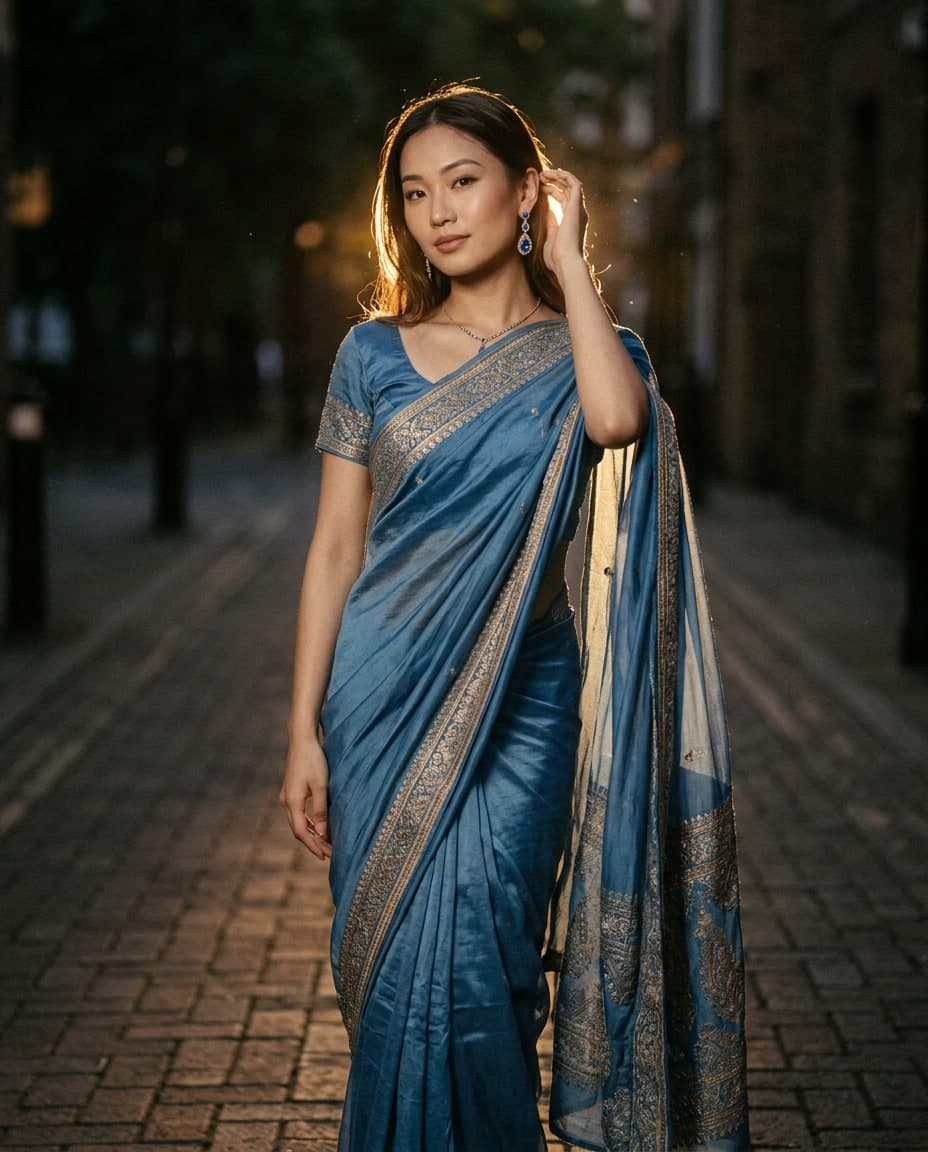
Lo-fi dusk twilight atmosphere, low-saturation warm-toned base, vintage film grain texture layered across the entire frame, warm golden backlighting rendering a soft and gentle halo, subtle lens flare accents, classic dark-toned night lighting; medium-shot portrait composition, the subject wears an elegant and grand traditional blue embroidered saree, premium quality silk fabric texture, hemlines and drape adorned with gold thread piping and ethnic patterns, natural and dimensional fabric pleats; wearing matching blue gemstone dangling earrings and a delicate matching necklace, intricately designed jewelry; standing angled sideways, looking at the viewer in the visual center of the frame, one hand gently raised to tuck hair behind the ear, the other hand resting naturally at the side, relaxed and languid pose; background is an outdoor paved brick street at night, dim ambient tones, backlight outlining and highlighting the strands of hair and the saree, soft and non-glaring color transitions; delicate and clean makeup, overall serene and gentle atmosphere, delicate and layered light and shadow, 8K ultra-high definition, masterpiece, best quality.

sareeportraitdusk
Tamil Silk WeddingNew

Tamil Silk Wedding

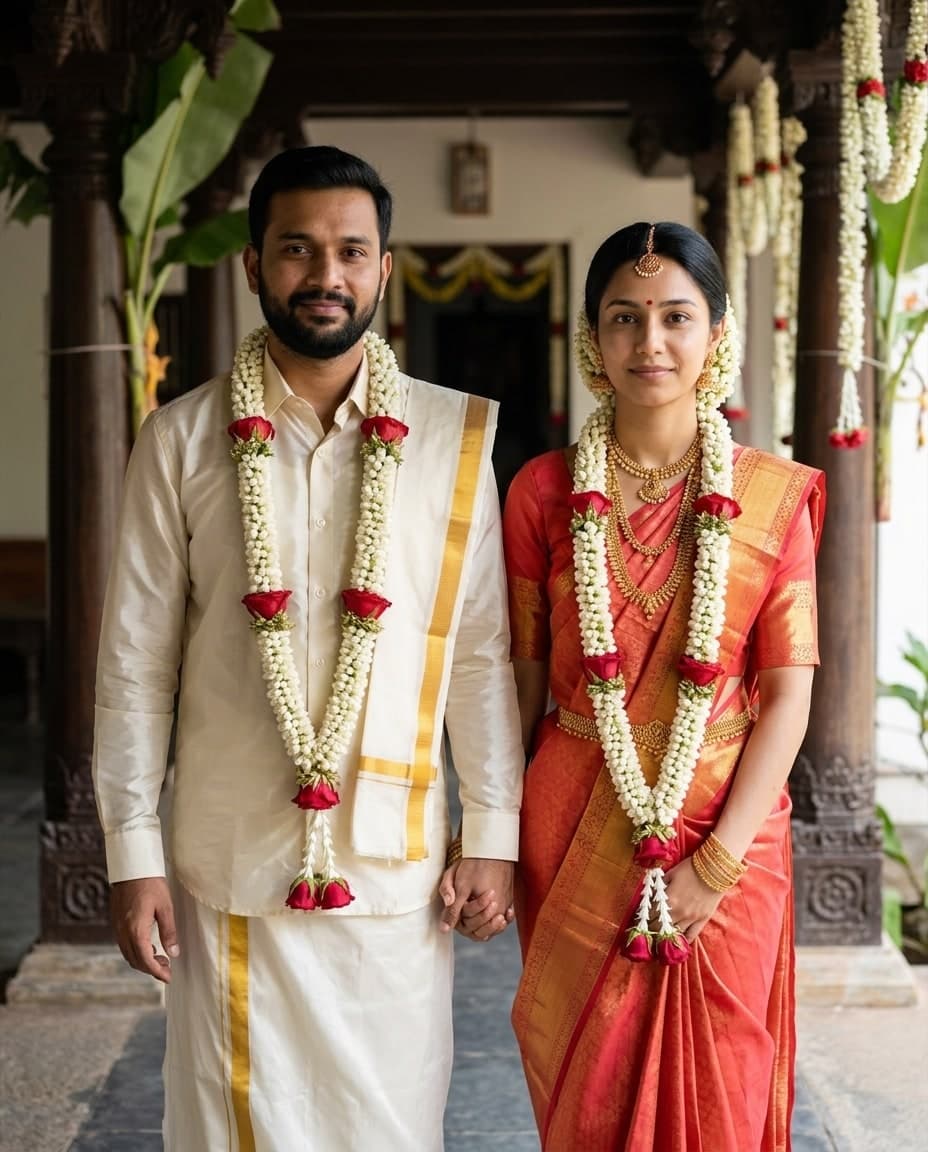
Create a photorealistic wedding portrait of exactly the two adults in the reference images. Image 1 is the man and image 2 is the woman. Use these photographs as the only identity references. Preserve both recognizable facial identities, natural skin tones, face shapes, eyes, noses, mouths, hairlines, facial hair, apparent ages and body proportions. Keep the man on the left and the woman on the right. They remain the same Indian individuals, with natural skin texture and believable gentle bridal grooming; no skin lightening, face replacement, de-aging or generic model faces. Replace their casual clothing with the specific attire below. Give them natural, comfortable body language, clear unobstructed faces and anatomically plausible hands. Make a vertical 4:5 medium portrait, approximately mid-thigh or waist upward, with sufficient space above both heads and around the shoulders for later cropping. Both faces should be turned toward the camera and recognizable. Use realistic wedding photography, coherent natural light, real fabric and jewellery textures, softly separated background and lifelike expressions. One photographic image with exactly two main people, no split-screen, illustration, text, watermark or decorative photo border. Avoid a Western wedding gown, tuxedo, church or champagne props. Specific wedding look and scene: A Tamil wedding couple on a shaded South Indian heritage-house veranda. The bride wears a rich coral-red Kanjeevaram silk sari with broad woven gold borders, a matching short-sleeved blouse, traditional layered gold necklaces, gold jhumkas, a neat central forehead ornament and a small bindi. Her hair is arranged in a low bun encircled with fresh jasmine flowers, leaving her face unobstructed. The groom wears a cream silk shirt with a gold-bordered white veshti and an angavastram over one shoulder. Both wear modest fresh jasmine-and-red-rose wedding garlands. Capture a natural pause as they walk side by side: he gently holds her hand low between them, shoulders relaxed, both looking toward the camera with quiet happy smiles. Include carved wooden pillars, banana-leaf decoration and jasmine garlands in the softly blurred background. Soft morning daylight emphasizes the lustrous silk weave and warm natural brown skin. The sari, jasmine, gold jewellery and veshti establish the regional look without adding elements from other regional wedding traditions.

weddingtamilsilk sari
Bengali Red WeddingNew

Bengali Red Wedding

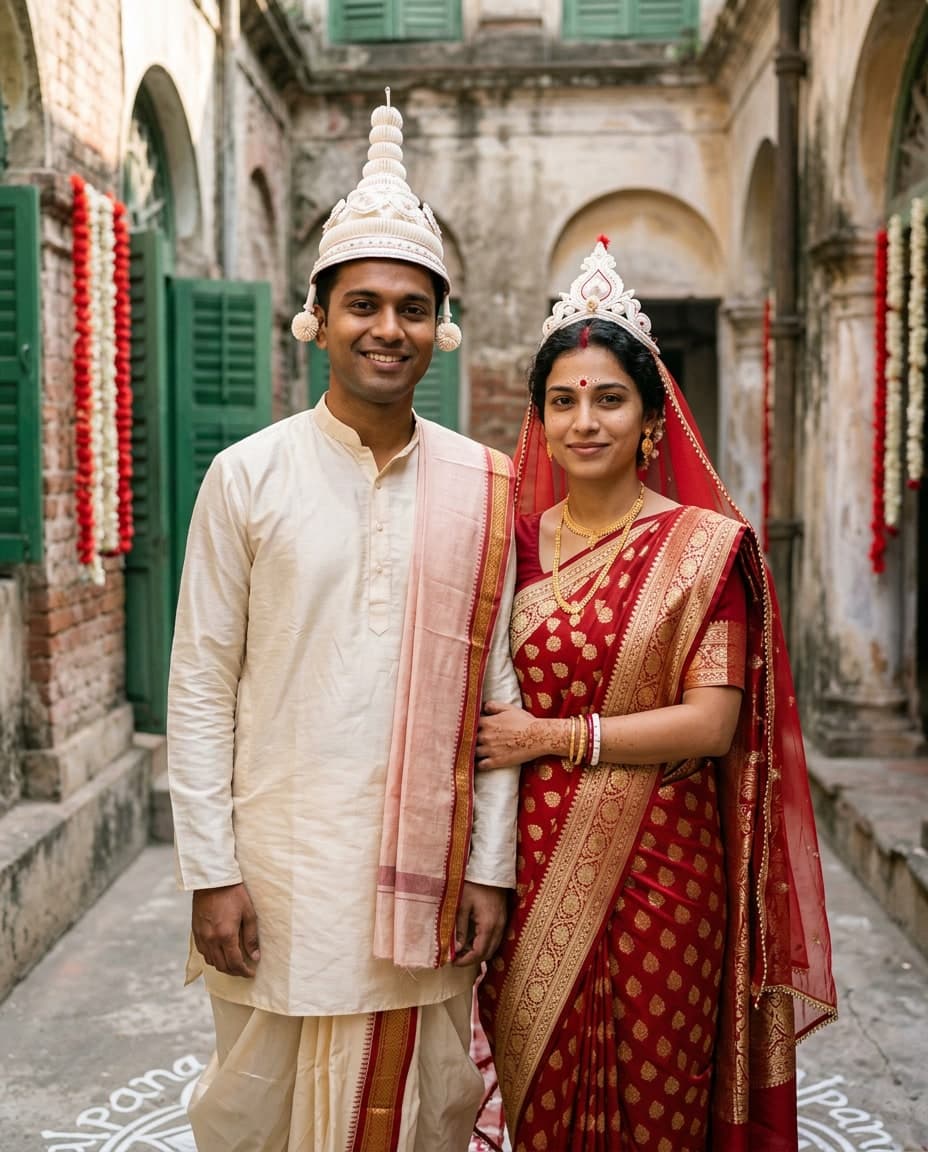
Create a photorealistic wedding portrait of exactly the two adults in the reference images. Image 1 is the man and image 2 is the woman. Use these photographs as the only identity references. Preserve both recognizable facial identities, natural skin tones, face shapes, eyes, noses, mouths, hairlines, facial hair, apparent ages and body proportions. Keep the man on the left and the woman on the right. They remain the same Indian individuals, with natural skin texture and believable gentle bridal grooming; no skin lightening, face replacement, de-aging or generic model faces. Replace their casual clothing with the specific attire below. Give them natural, comfortable body language, clear unobstructed faces and anatomically plausible hands. Make a vertical 4:5 medium portrait, approximately mid-thigh or waist upward, with sufficient space above both heads and around the shoulders for later cropping. Both faces should be turned toward the camera and recognizable. Use realistic wedding photography, coherent natural light, real fabric and jewellery textures, softly separated background and lifelike expressions. One photographic image with exactly two main people, no split-screen, illustration, text, watermark or decorative photo border. Avoid a Western wedding gown, tuxedo, church or champagne props. Specific wedding look and scene: A traditional Bengali wedding portrait in an intimate Kolkata heritage courtyard. The bride wears a deep red Banarasi silk sari with gold woven motifs and a red veil drawn back so her complete face is visible. Add restrained gold bridal jewellery, red-and-white shakha-pola bangles, a round red bindi and delicate white chandan accents along the brow without changing facial structure. She wears a modest white sholapith bridal mukut. The groom wears an ivory kurta, a cream Bengali dhoti with a red-and-gold border, a light red-bordered shawl and a traditional white sholapith topor. Make the mukut and topor distinct, correctly placed and fully inside the frame. They stand close in a relaxed three-quarter pose, her hand resting naturally on his arm, faces turned to the camera with genuine small smiles. Warm courtyard light, softly blurred red-and-white floral garlands, old limewashed walls and a subtle alpana floor pattern visible at the very bottom. Prioritize the same two faces and authentic fabric texture; do not let forehead decoration obscure identity.

bengali weddingred saricouple
Ancient Tea Pavilion Noble Lady Portrait

Ancient Tea Pavilion Noble Lady Portrait

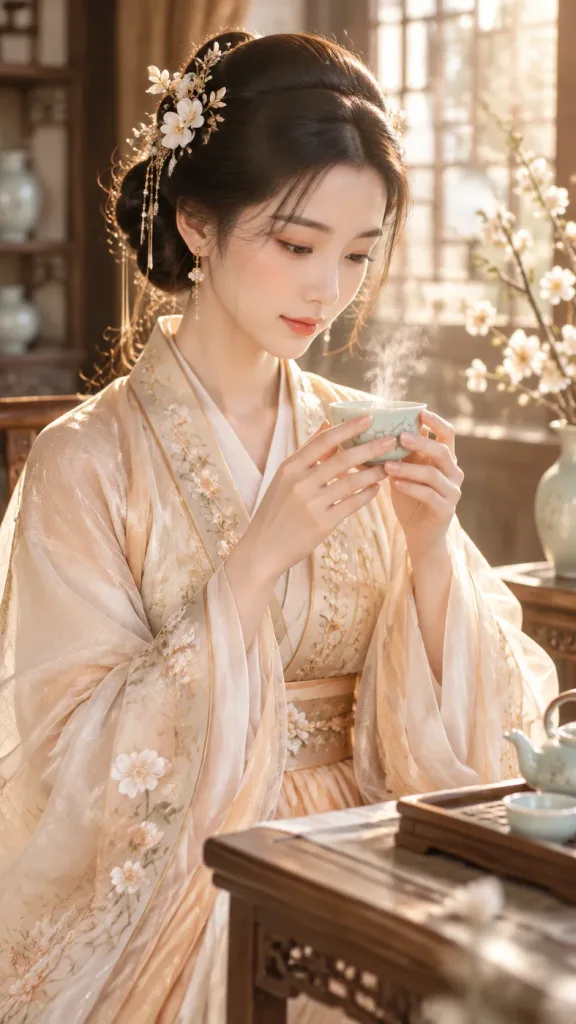
A realistic ancient Chinese style portrait of a noble Eastern female lead, visual age approximately [20–28 years old], sitting quietly by a wooden tea table in a warm tea pavilion. She has a soft oval face, clean facial contours, gentle almond eyes, and a quiet, tranquil expression with a subtle, gentle smile, looking down at a ceramic tea cup held delicately in both hands. Her makeup features an [apricot pink] gentle palette with fair, translucent skin showing natural pore texture, soft warm brown and apricot eye shading, delicate lashes, soft blush, and moist natural apricot-pink lips. Her black hair is styled in an elegant low updo with face-framing strands, adorned with light gold leaf hairpins, milky white floral ornaments, small pearl pendants, and slender gold tassels paired with matching drop earrings. She wears an ancient layered cross-collar garment with a flowing long skirt in an [apricot white and champagne gold] palette made of soft silk and delicate gauze, decorated with subtle traditional floral and vine embroidery on the collar and wide flowing sleeves, tailored with modesty and dignified grace. Side-front half-body to three-quarter shot. In the softly blurred background are wooden lattice windows, ceramic tea sets, and a vase with white flower branches. Gentle steam rises from the hot tea cup, creating a soft atmospheric mist beside her face. Illuminated by soft warm-white morning light streaming through the side-rear lattice window, producing delicate rim highlights on her hair and embroidery, complemented by soft, clean front fill light on her face.

portraitancient stylehanfu
Her TraditionNew

Her Tradition

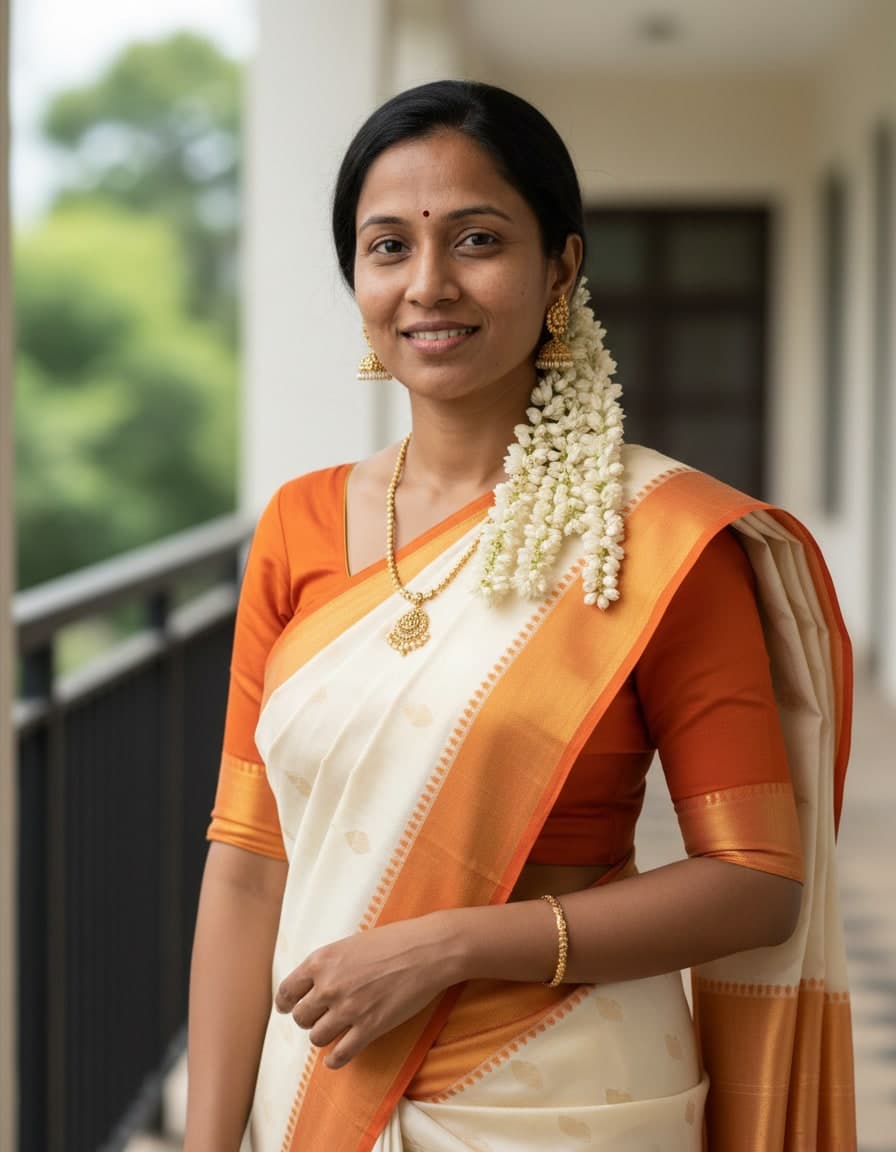
The subject is dressed in a traditional, elegant silk saree featuring a cream-colored body with a broad, vibrant orange border and a matching orange silk blouse with elbow-length sleeves. A thick, lush garland of fresh white jasmine flower…

sareetraditionaljasmine
Rinpa Style Decorative Foil Illustration

Rinpa Style Decorative Foil Illustration

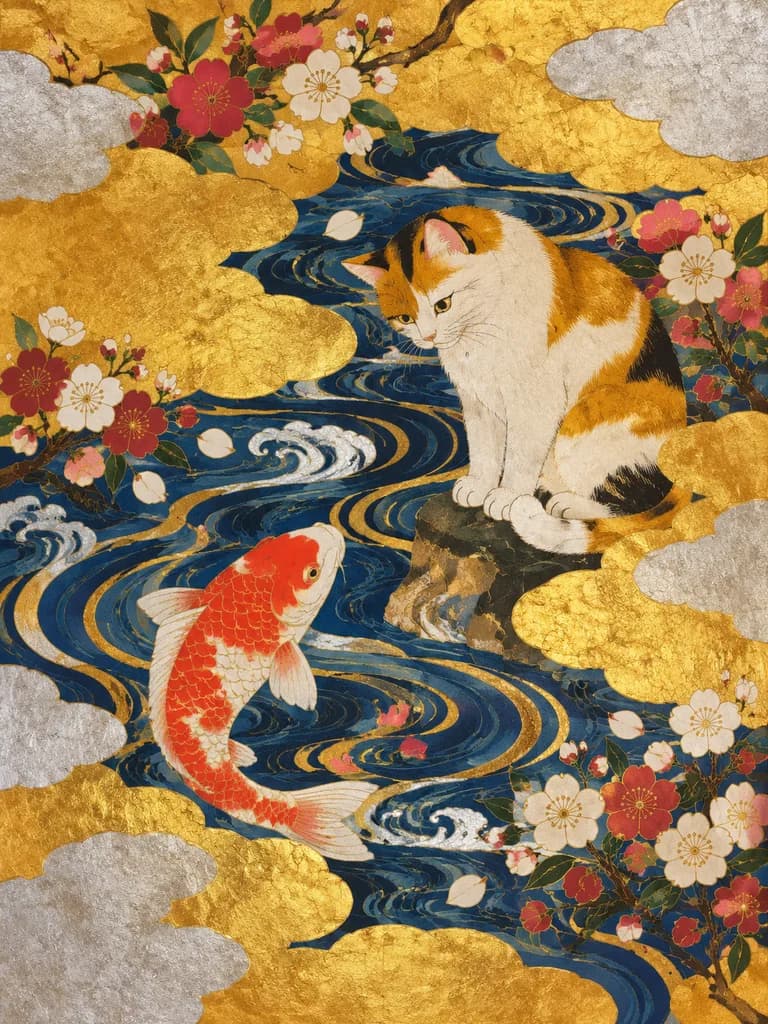
A decorative artwork in the [Rinpa] style, reimagining the reference illustration. Features bold gold and silver clouds with flowing [flowing water and flower] patterns. Emphasizes flat, graphic decorative beauty with vivid colors and gold and silver foil textures. Faithfully preserves the composition and characters of the reference illustration.

rinpajapanese artgold foil
Saree WaterplayNew

Saree Waterplay

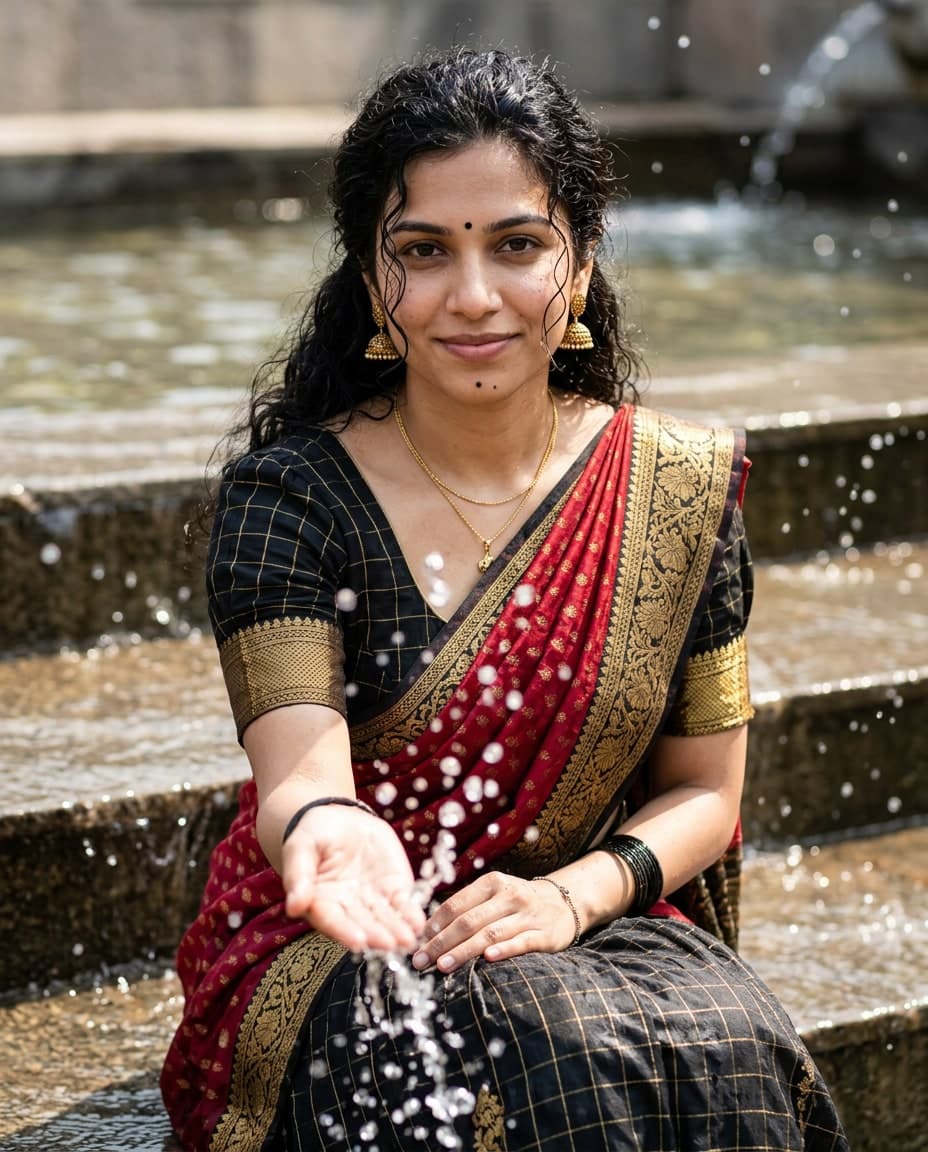
Keep the facial features of the person in the reference photo. Ultra-realistic portrait photography, medium close-up to half-length composition, with the subject close to the camera and filling a large part of the frame. A woman sits in front of a wet stone-step water feature, positioned in the center of the frame slightly to the right; the camera is slightly above her chest level, nearly eye-level and shooting slightly downward; the subject is in frame from the top of her head to around her knees, her face clear and centered; her right hand reaches out toward the front of the camera, palm up, catching water or gently splashing it; in the foreground there are many splashing water droplets, both sharp and blurred in alternation, creating a strong sense of depth and a dynamic moment; the woman looks at the camera with a quiet, gentle gaze and a shy smile, with a small black Indian bindi at the center of her forehead and a small gold bindi below it, a small black mole near her chin, fair skin, natural makeup, light eyeliner, pale rose lips; her hair is thick, jet-black and long, slightly damp, naturally combed back and fluffy at the crown, with the hair at the back hanging down, and messy wet strands on both sides of her cheeks clinging near her forehead and the side of her face, with real hair strand detail clearly visible; she wears a traditional Indian saree, the top being a black short-sleeved blouse with a fine gold-thread check pattern, the sleeves slightly puffed and the cuffs with wide gold embroidered borders, a vivid deep-red saree fabric draped diagonally across the chest, the red fabric with a dense fine gold weave, its edges a wide black-and-gold embroidered border with traditional Indian floral patterns and a gold brocade texture, and below it the black saree skirt visible with gold-line check pattern and dark-gold embroidery, the fabric slightly glossy and naturally creased when wet; she wears traditional gold jhumka drop earrings, a fine gold necklace with a small pendant, black bangles and a fine bracelet on her wrist, the jewelry having real metal reflections but not exaggerated; the background is wet gray-brown stone steps or a stepped fountain, with a shallow stream of water flowing slowly between the steps, the background softly blurred with a shallow depth of field, the water-surface reflections, stone-step texture and scattered water droplets visible, the overall setting resembling an Indian outdoor pool or temple steps; the lighting is bright natural daylight, noon or afternoon sunlight illuminating the face and saree, the water droplets producing crystalline highlights, soft shadows but with real contrast, the skin with a natural sheen, and the wet hair and wet fabric with obvious reflective detail; the color tone is dominated by black, gold, deep red, warm brown skin tones and gray-brown stone steps, the red saree full and rich, the gold embroidery gorgeous and clear, the background in warm gray contrasting with the cool white of the water light, the overall color real and vivid but not over-saturated; the photographic style is high-end realistic portrait photography, Indian traditional-costume water-scene portrait photography, cinematic natural-light documentary photography, 85mm portrait lens or 70mm telephoto compression, f/1.8 shallow depth of field, the subject's eyes, face, jewelry and saree embroidery sharp and clear, the foreground water droplets partly in motion blur and round bokeh, real camera-shot texture, high-definition detail, real skin texture, real wet fabric folds, real water-splash physics

sareewater splashportrait
Calligraphic Ink Cityscape Poster

Calligraphic Ink Cityscape Poster

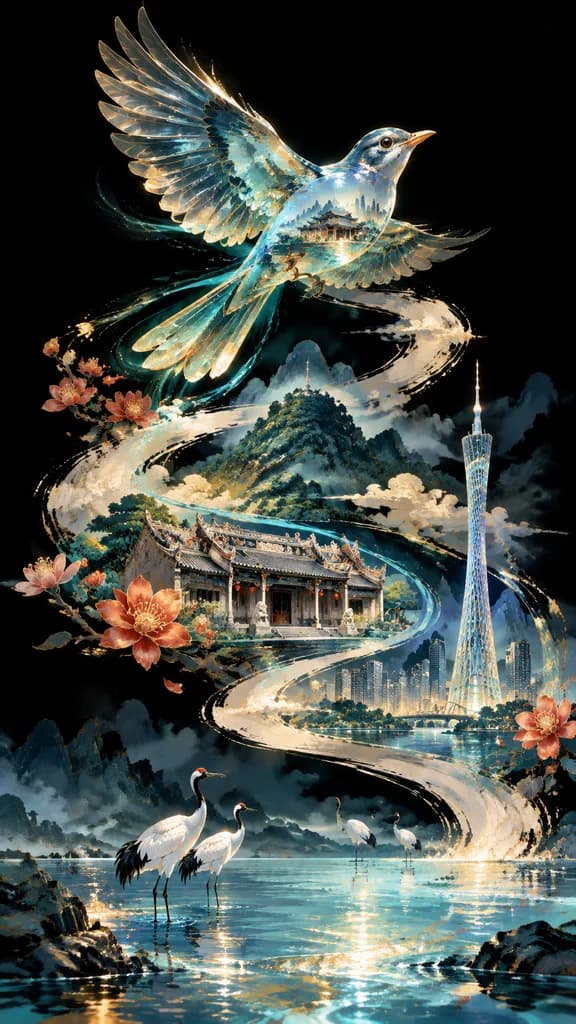
An artistic fusion of Chinese ink calligraphy and modern architectural illustration on a deep black background. A thick, vigorous ink brushstroke winds across the composition in an S-shaped curve, forming the central visual flow. Above the curve, a [thrush] with spread wings forms the core subject, its body rendered like transparent glass reflecting miniature traditional architectural scenes with glowing blue-green light streams and delicate gold-edged outlines. Along the ink curve, iconic landmarks of [Guangzhou]—including Baiyun Mountain, Chen Clan Ancestral Hall, and the Canton Tower—are arranged with intricate architectural details in blue-green and pale gold tones, surrounded by ethereal kapok blossoms and ink-wash clouds. In the foreground, a serene, mirror-like light blue water surface reflects sparkling light with several elegant white cranes standing in graceful poses. In the far background, layered indigo ink mountains fade into the distance. Radiant central lighting, strong chiaroscuro contrast, cool blue-green palette accented with warm gold.

chinese inkcalligraphycityscape
Japanese New Year Kirie Icon Grid

Japanese New Year Kirie Icon Grid

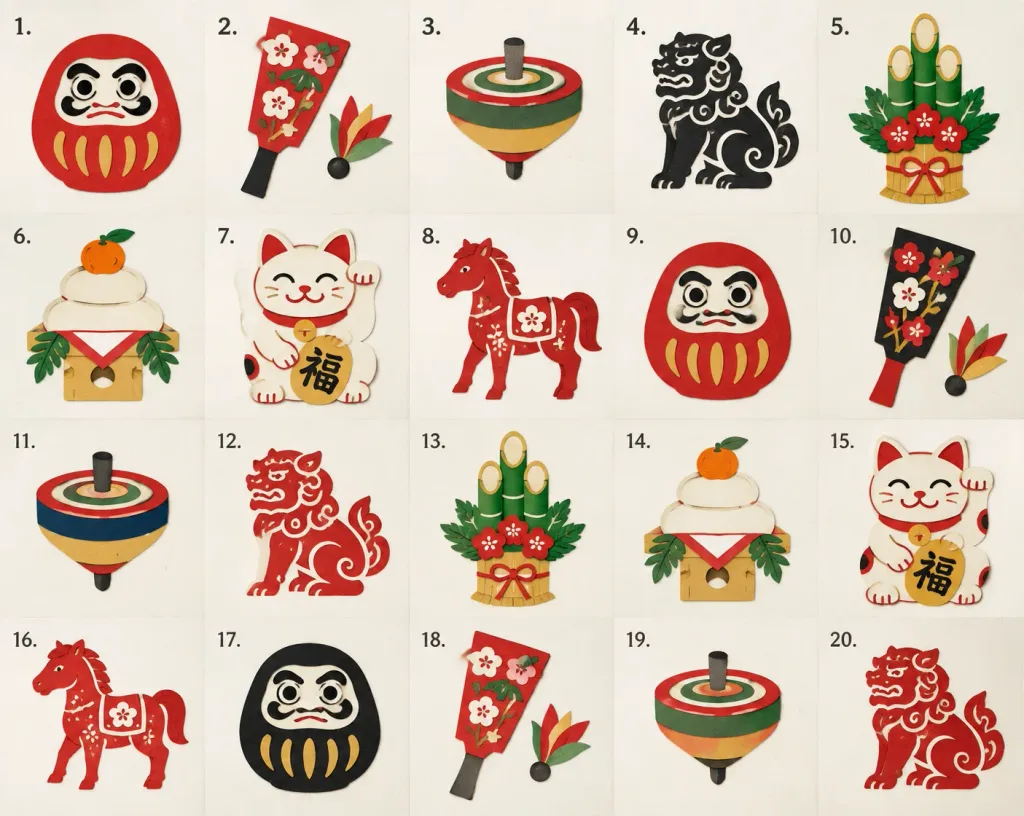
A set of icons in a Kirie (traditional Japanese paper-cutting) style featuring Japanese New Year decorations, including [Daruma, Hagoita, Koma, Komainu, Kadomatsu, Kagami Mochi, Maneki Neko, Horse]. The icons are arranged neatly in a grid of 4 rows and 5 columns, ordered sequentially from left to right, top to bottom. Each icon cell features a small numbered label indicating its sequence in the top-left corner. Crisp layered paper textures, clean cutout silhouettes, isolated on a clean neutral background.

icon setkiriepaper cut
South Indian Silk PortraitNew

South Indian Silk Portrait

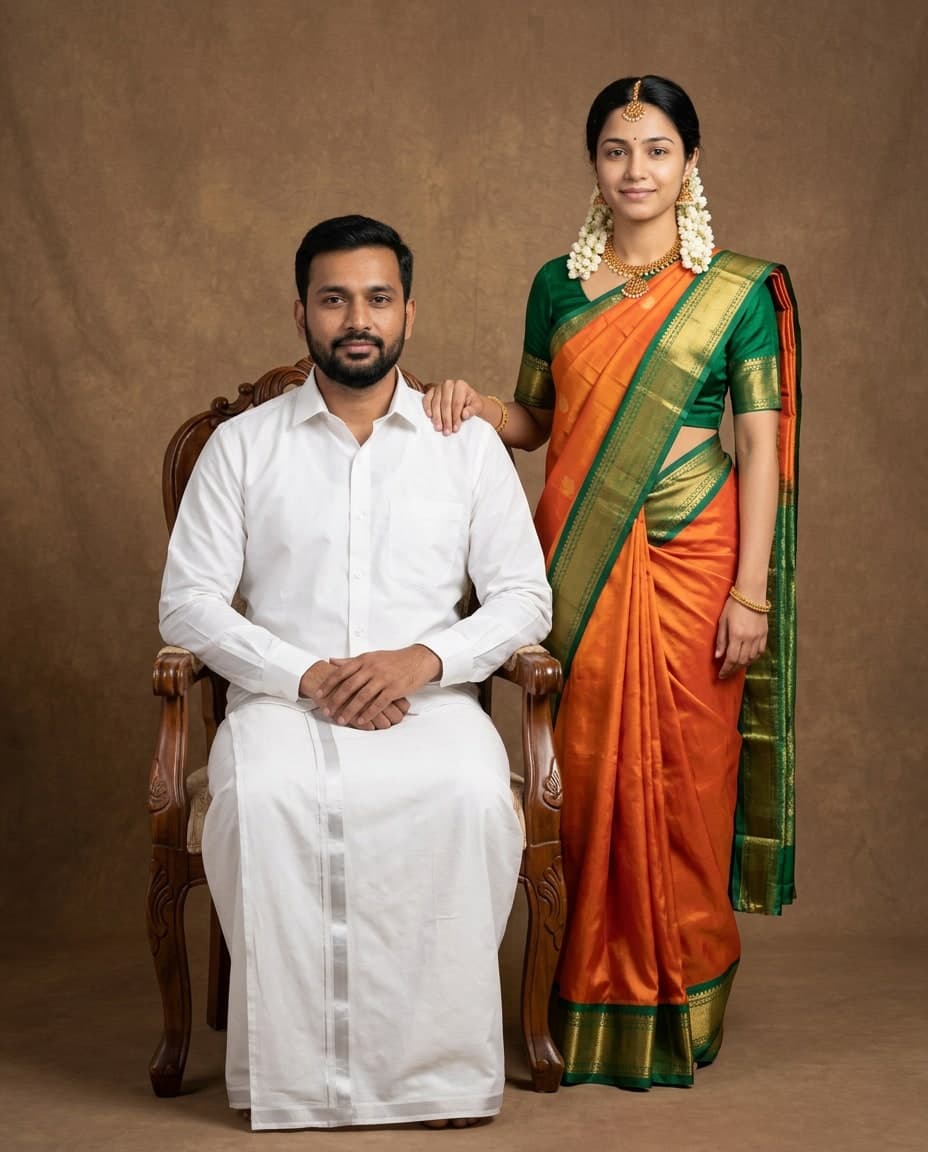
Generation priority: first, keep both people's facial identity; second, complete the specified outfit change; third, accurately complete the specified body poses; fourth, complete the studio background and lighting. There are only two adults in the image. Reference photo 1 corresponds only to the man himself. Keep the recognizable head features of the man in reference photo 1, including his original face shape, eyes and brows, nose shape, lips, jaw contour, skin tone, apparent age, hairline and beard state, while also keeping his natural shoulder width, torso thickness, waist and belly volume and overall build. Reference photo 2 corresponds only to the woman herself. Keep the recognizable head features of the woman in reference photo 2, including her original face shape, eyes and brows, nose shape, lips, cheekbones, jaw contour, skin tone, apparent age, hairline and smile characteristics, while also keeping her natural shoulder width, arm thickness, waist and belly volume, bust-waist-hip proportions and overall build. Each face corresponds to its own reference photo: do not swap them, do not blend them, do not beautify or reshape them. The man is fully changed into traditional South Indian white clothing: a pure white fitted long-sleeve shirt, with both sleeves kept long and extending to the wrists, not rolled up; below, a pure white dhoti, with the waist wrap structure and front pleats clearly visible, the white fabric falling naturally to the ankles. Only the white long-sleeve shirt and white dhoti appear on the man. The woman is fully changed into an orange, green and gold South Indian Kanchipuram silk saree. The upper body is an emerald-green pure silk short-sleeve choli; the outer layer is an orange silk saree with a wide emerald-green border and gold zari weaving. The saree fully wraps the waist and both legs, forming clear vertical pleats at the front of the waist and falling to the ankles, with the pallu, which has a green and gold patterned border, draped diagonally across the chest, over the left shoulder and falling down behind the shoulder. The woman wears only this green choli and orange, green and gold saree; the original clothing in reference photo 2 does not appear at all. She wears gold temple jewelry and a traditional South Indian bun hairstyle decorated with white jasmine flowers, and the hair, jewelry and pallu do not cover the face. Fixed poses: the man sits in the exact center of a carved solid-wood armchair on the left side of the frame, facing the camera, his back naturally straight. The man's left hand rests palm-down on his left thigh and his right hand rests lightly on top of the left hand, the two hands only overlapping on his knee, arms not crossed, hands not touching the woman. The man's expression is calm, looking directly at the camera. The woman stands on the right side of the frame, half a step behind the chair, her body facing the camera. The woman's right arm is bent, and her right hand alone rests lightly on the man's left shoulder; her left arm extends naturally straight down from the shoulder along the left side of her body, her left hand hanging beside her own left thigh. Her left hand does not touch the man, does not touch her right hand, and does not rest on the chair back. The only physical contact between the two is her right hand on the man's left shoulder. The woman smiles warmly and looks directly at the camera. Use an eye-level vertical full-body composition, with the man, the armchair and the woman all fully in frame. The frame runs from above the heads of the two people down to their feet, with the woman's feet, the man's full dhoti and the bottom of the chair clearly visible, not cropping the knees, ankles or feet. The background is a formal studio backdrop with a warm-brown fabric texture, lit with large-area soft light from the front and slightly to the side plus slight fill light, clearly lighting both faces, the new clothing, the silk weave and the gold jewelry, preserving true skin tones and natural skin texture. The final result keeps: the man's facial identity from reference photo 1, the woman's facial identity from reference photo 2; the man's white long-sleeve shirt and white dhoti; the woman's complete orange, green and gold saree; the man's hands overlapping on his knees; the woman with only her right hand on the man's left shoulder and her left arm hanging naturally along her body. Avoid both hands placed beside the man's shoulders, the woman's arms crossed, the man's rolled-up sleeves, remnants of the original clothing, faces crossed between the two people, and a cropped lower body.

south indiansareecouple
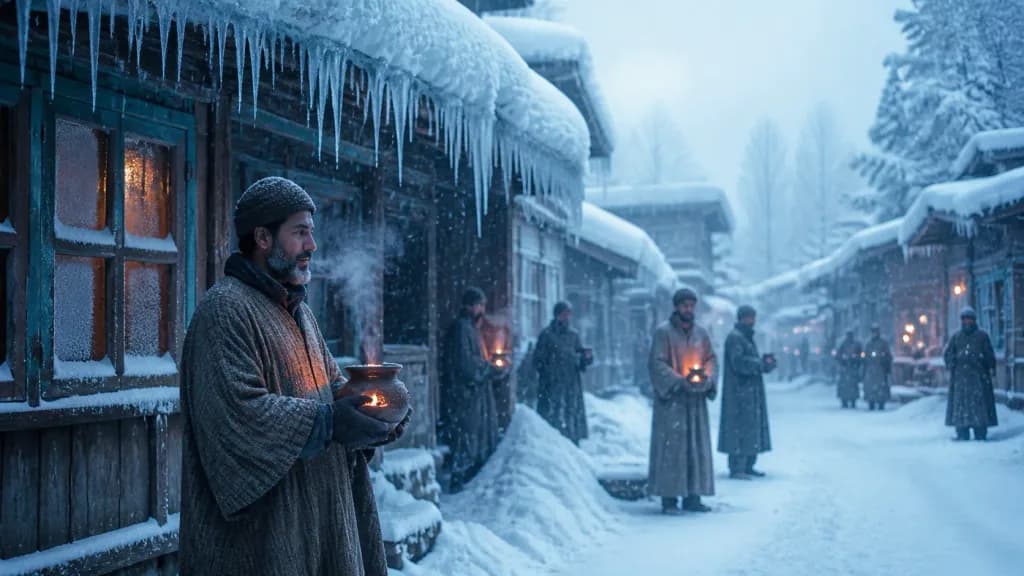
Kashmir Winter During Chillai Kalan

Kashmir Winter During Chillai Kalan

A cinematic winter scene in [Kashmir] during [Chillai Kalan]. Heavy snowfall blankets traditional [wooden houses], with rooftops buried under thick snow and long icicles hanging from the eaves. Frost clings to windowpanes. Local people dressed in traditional woolen [pherans] stand outdoors and near doorways, holding glowing [kangri fire pots] close for warmth. Visible breath plumes into the freezing air as dense snowflakes drift down. Moody overcast sky, a cold [blue-white color palette] contrasted by the warm [orange glow] of embers. Documentary-style cinematic realism, shallow depth of field, atmospheric winter storm.

kashmirwintersnowfall
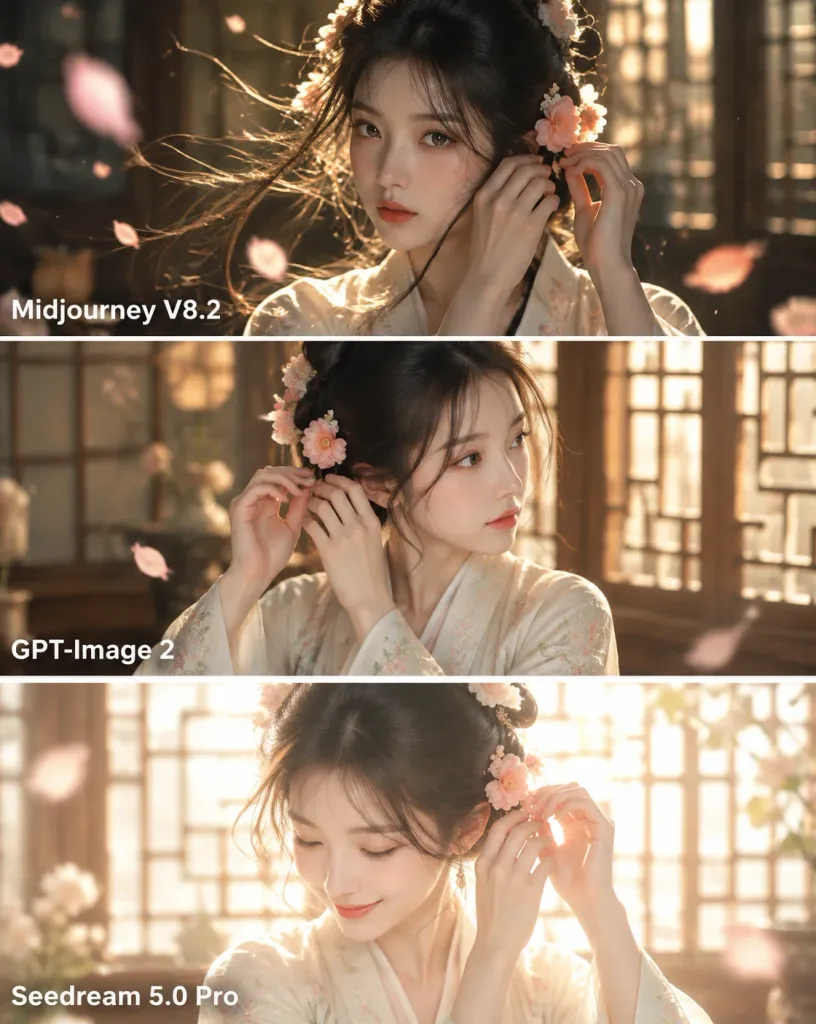
Three Panel Hanfu Portrait Model Comparison

Three Panel Hanfu Portrait Model Comparison

A vertical three-panel comparison collage showing the same Chinese traditional aesthetic portrait in three distinct rendering styles, separated by thin white horizontal dividing lines in a 4:5 portrait ratio. Overall Subject & Setting: In all three panels, [a young East Asian woman in ivory hanfu] is set inside [a warm ancient Chinese room with wooden lattice windows]. She adjusts [a peach-pink flower] hair ornament near her ear with both hands. Her dark hair is loosely pinned up with soft wisps around her face. The environment features warm golden-hour backlighting, soft atmospheric haze, floating dust motes or flower petals, and shallow depth of field. Panel Details: - Top Panel: High-contrast, moody cinematic film still style with dynamic windblown hair, glowing rim light, petals drifting across the foreground, and refined realistic skin texture. The woman gazes toward the camera with an elegant, serious expression while placing the flower by her ear. Lower-left text label: "[Midjourney V8.2]". - Middle Panel: Soft beauty-retouch aesthetic with clean, polished skin, cream hanfu fabric showing subtle embroidered floral patterns, and warm window light. She is turned three-quarters to the right, looking sideways as she pins the flower. Lower-left text label: "[GPT-Image 2]". - Bottom Panel: Bright, soft realism with intense lattice backlight creating a glowing halo around her hair and fingers, displaying a gentle smile as she looks downward. Lower-left text label: "[Seedream 5.0 Pro]". Typography: Large white sans-serif text placed cleanly in the lower-left corner of each panel, with a subtle drop shadow for readability. No extra watermarks, borders, or UI elements.

hanfucomparisoncollage
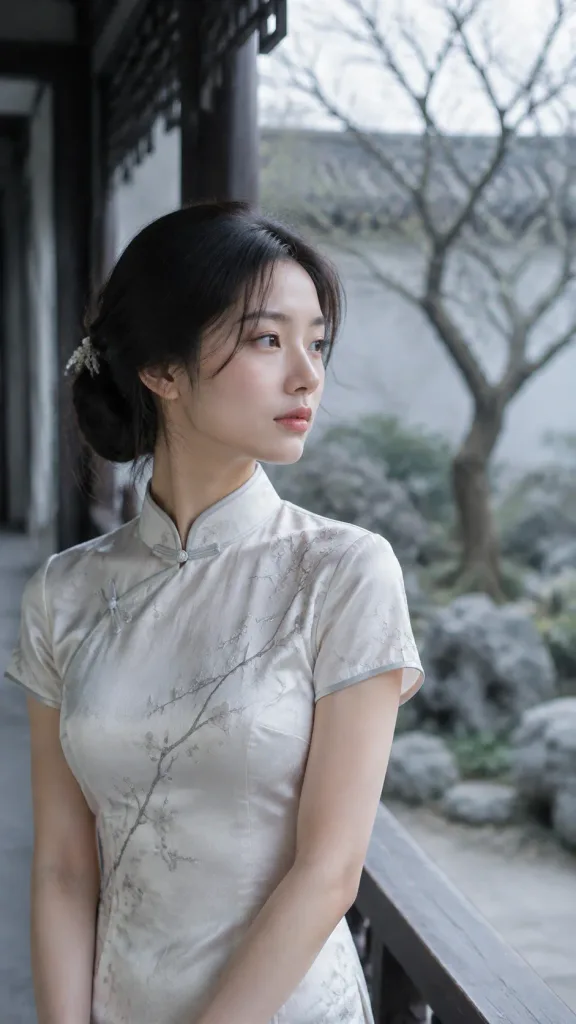
East Asian Woman in Silk Qipao

East Asian Woman in Silk Qipao

A medium-shot candid daily life photograph of an [East Asian young woman] standing inside a covered corridor that opens onto a small courtyard garden. Waist-up framing, shot on an 85mm lens with shallow depth of field, blurring the grey stone garden and a single bare-branched tree behind her. The woman, in her early 20s, has almond-shaped eyes gazing gently toward the garden, a straight refined nose, and fair beige skin showing subtle subsurface scattering and micro-highlights on her cheekbones. She wears a [moonwhite silk qipao with plum blossom embroidery in pale silver-grey thread], featuring a mandarin collar and short sleeves, with the fabric exhibiting a soft, muted sheen. She stands with one shoulder turned toward the open garden, arms relaxed, with a few stray wisps of hair moved by a faint breeze. Lit by cool, diffuse overcast daylight entering through the open corridor wall, creating gentle, shadow-free illumination. Contemplative and serene atmosphere with subtle ISO 400 film grain texture in the shadow areas.

portraitqipaotraditional
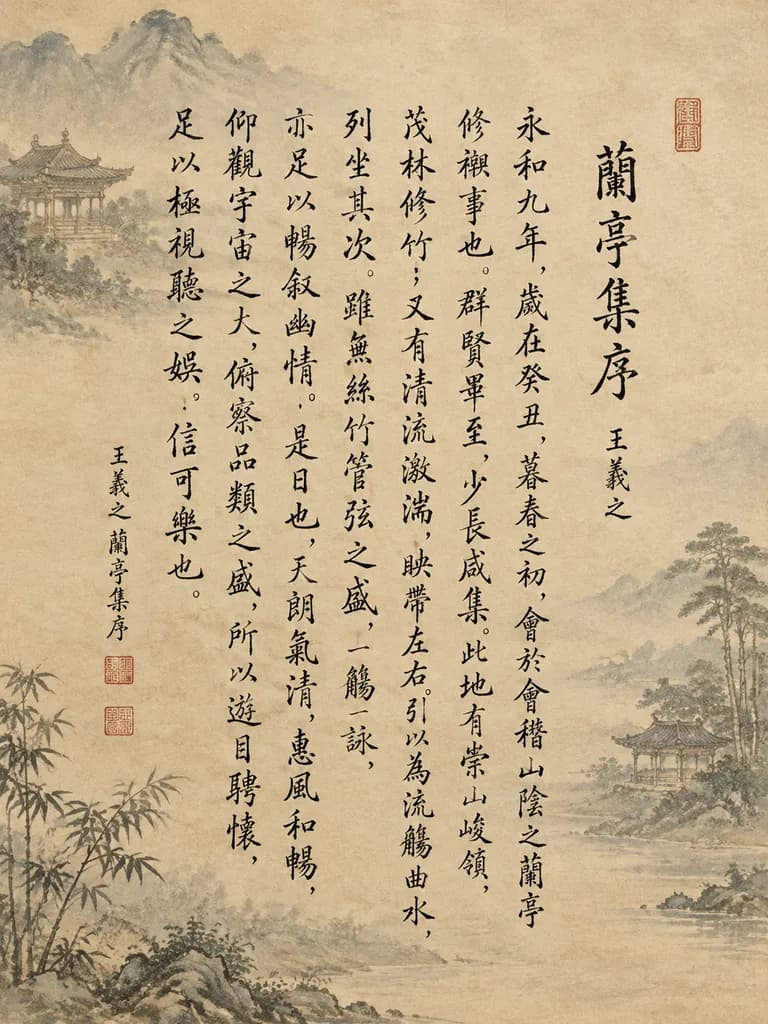
Classical Chinese Calligraphy Scroll

Classical Chinese Calligraphy Scroll

A traditional Chinese calligraphy scroll featuring the text of [Wang Xizhi's 'Lantingji Xu']. The foreground displays clear, elegant semi-cursive calligraphy written on aged rice paper. The background shows a masked, subtle landscape wash painting matching the [mood of 'Lantingji Xu'], with misty pavilions, bamboo groves, and winding streams blending softly behind the calligraphy text.

calligraphychinese artscroll
South Silk LookNew

South Silk Look

Use the uploaded selfie as the only identity reference. Create a highly realistic traditional South Indian silk outfit portrait featuring the same person. The person should wear a refined South Indian inspired silk traditional outfit with rich fabric texture, elegant gold accents, traditional jewelry, and a graceful ceremonial pose. The background should feel warm and cultural, such as a temple-inspired corridor, traditional home setting, festive lamps, flowers, and soft golden light. Preserve the person’s recognizable facial identity and overall appearance from the uploaded selfie. Do not specify or change hair color, skin tone, ethnicity, or race. Use realistic silk texture, refined folds, tasteful jewelry details, warm natural lighting, cultural elegance, and premium portrait photography. Style: photorealistic South Indian traditional fashion portrait, silk outfit, festive temple-inspired atmosphere, warm golden lighting, high detail.

south indiansilk sareetraditional
Silk Kimono BrideNew

Silk Kimono Bride

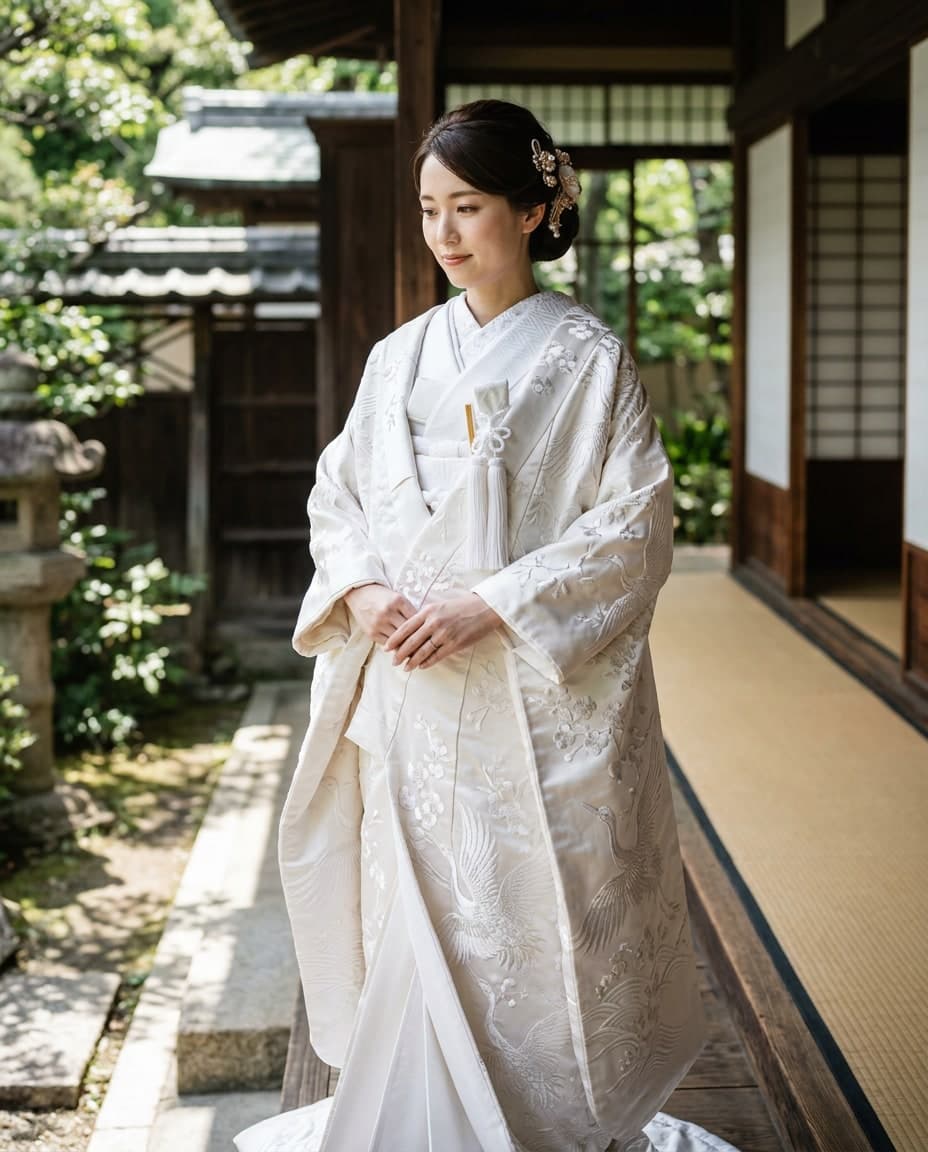
High quality, real, HDR, HD, Japanese wedding dresses are usually white, kimono wedding dresses with exquisite embroidery, traditional and elegant. The material is usually silk or cotton and linen Negative prompt: Low quality, watermark, mosaic, nudity

kimonojapanese weddingbride
German GroomNew

German Groom

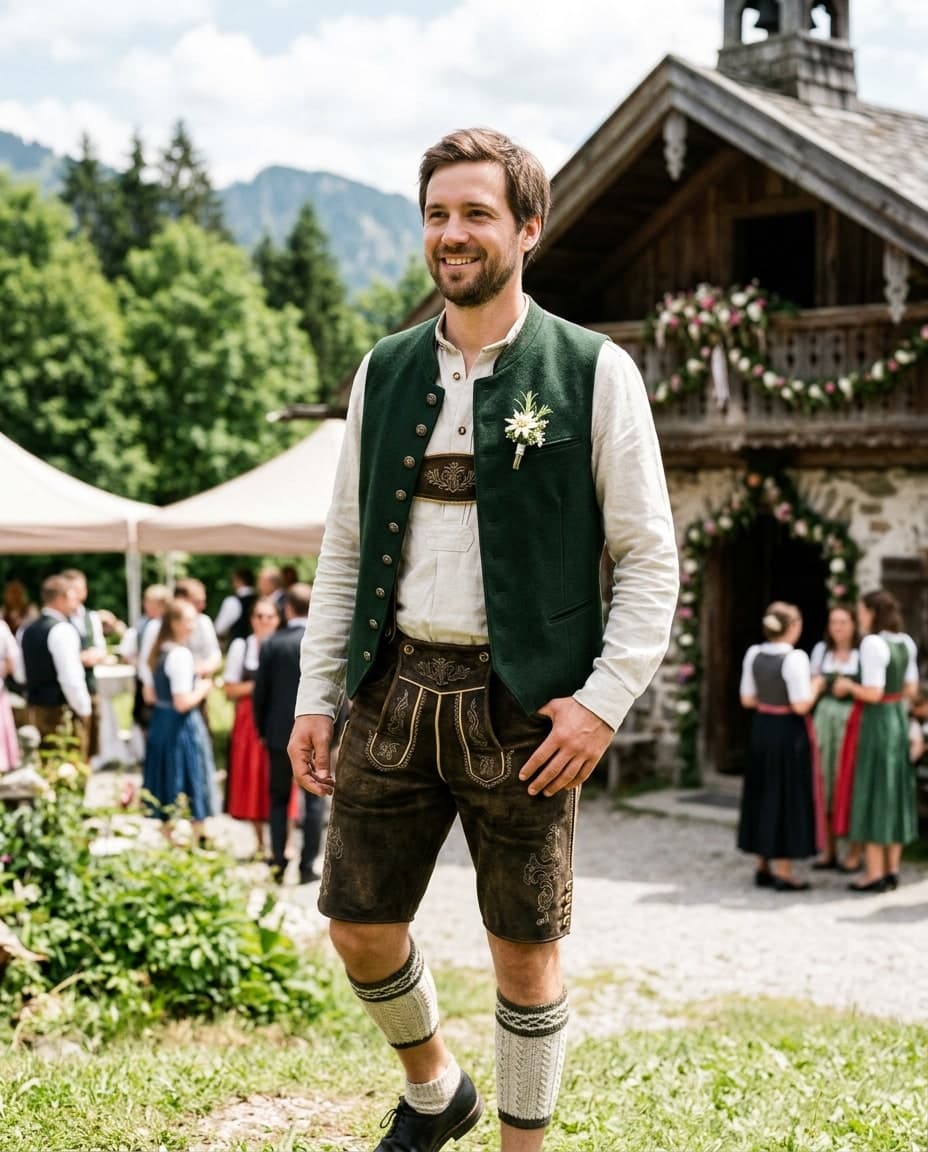
High quality, real, HDR, HD, German grooms usually choose to wear traditional German national costumes, such as Leder shorts suits. This design shows the tradition and pride of German men. The material is usually leather or cotton blend

groomlederhosengerman wedding
Low-Key Kimono Portrait with Censor Bar

Low-Key Kimono Portrait with Censor Bar

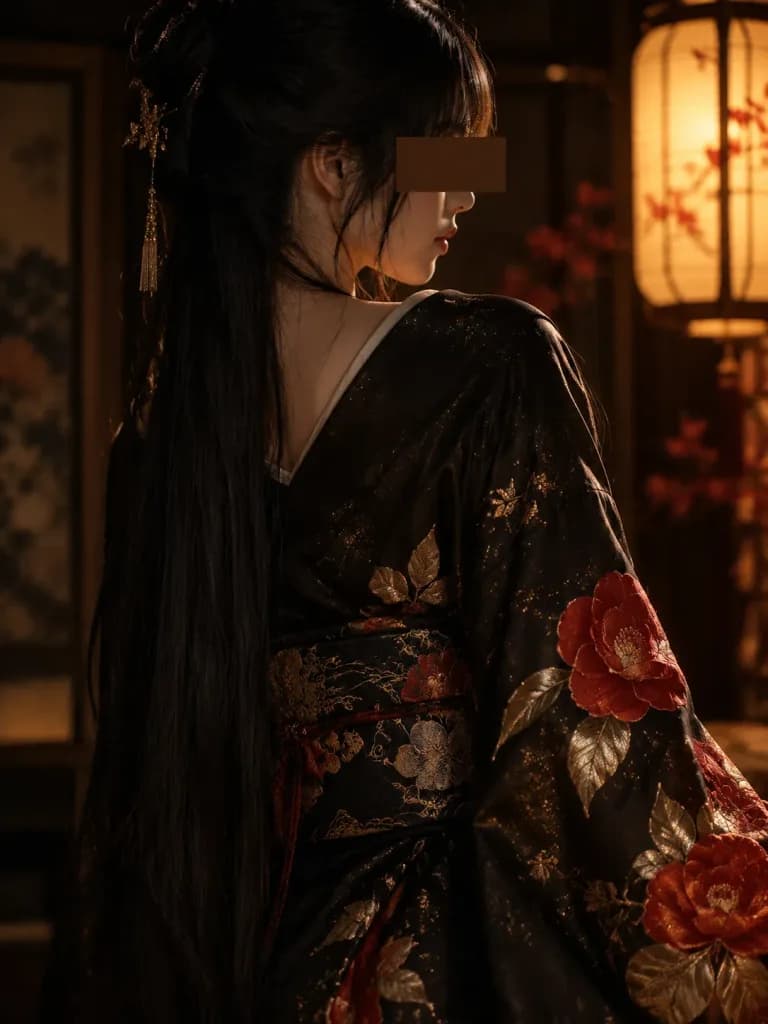
A cinematic, low-key portrait of a mysterious [young East Asian woman] viewed from behind and slightly in profile within a dim traditional interior at night. She has extremely long, straight [black hair] cascading down her back in a loose half-up hairstyle with wispy strands at her neck. Her upper face is obscured by a flat opaque rectangular censor bar in warm dark brown. She wears an elegant [black silk kimono] with subtle gold speckling, a patterned obi belt, and large embroidered red camellia-like flowers with golden leaves on the sleeves and lower fabric. Warm amber lantern light illuminates the scene from the right, casting deep shadows on the left. Softly blurred background featuring one glowing paper lantern and faint red floral accents. Composition is a close medium shot from shoulder to waist, shallow depth of field, emphasizing glossy hair texture, rich fabric embroidery, and dramatic chiaroscuro contrast. Photorealistic, warm highlights, deep blacks.

kimonolow-keychiaroscuro
Sherwani RoyaltyNew

Sherwani Royalty

Use the uploaded selfie as the only identity reference. Create a highly realistic portrait of the same person wearing a traditional Indian sherwani in a royal ceremonial style. The person should stand confidently in an elegant embroidered sherwani with refined traditional accessories. The pose should feel dignified, calm, and powerful. Use a luxurious heritage background such as a palace corridor, carved doorway, decorated courtyard, or warm ceremonial interior. Preserve the person’s recognizable facial identity and overall appearance from the uploaded selfie. Do not specify or change hair color, skin tone, ethnicity, or race. Use realistic textile details, embroidered patterns, natural fabric structure, soft warm lighting, elegant portrait composition, and premium fashion editorial quality. Style: photorealistic Indian sherwani portrait, royal traditional menswear styling, ceremonial fashion, heritage palace background, high detail, sharp focus.
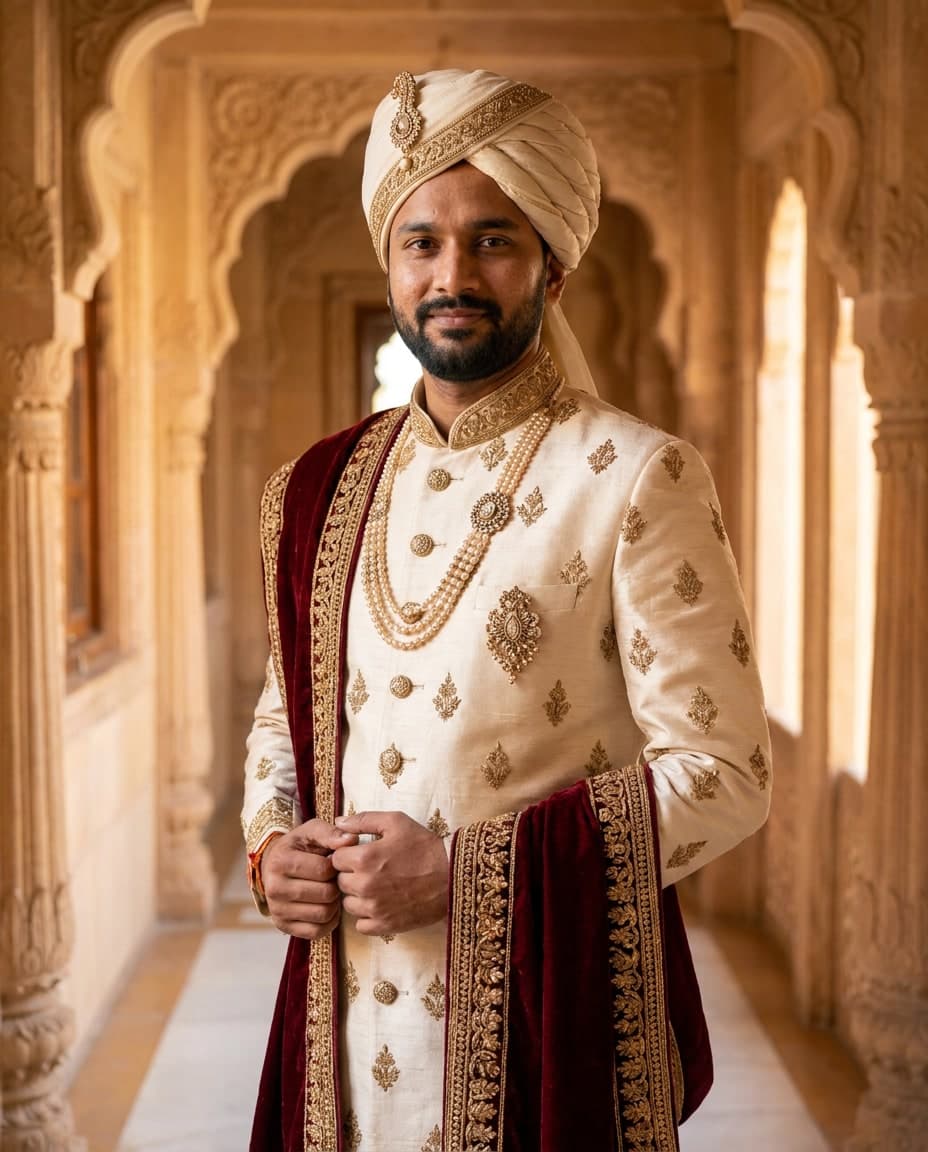
sherwaniindian weddingpalace
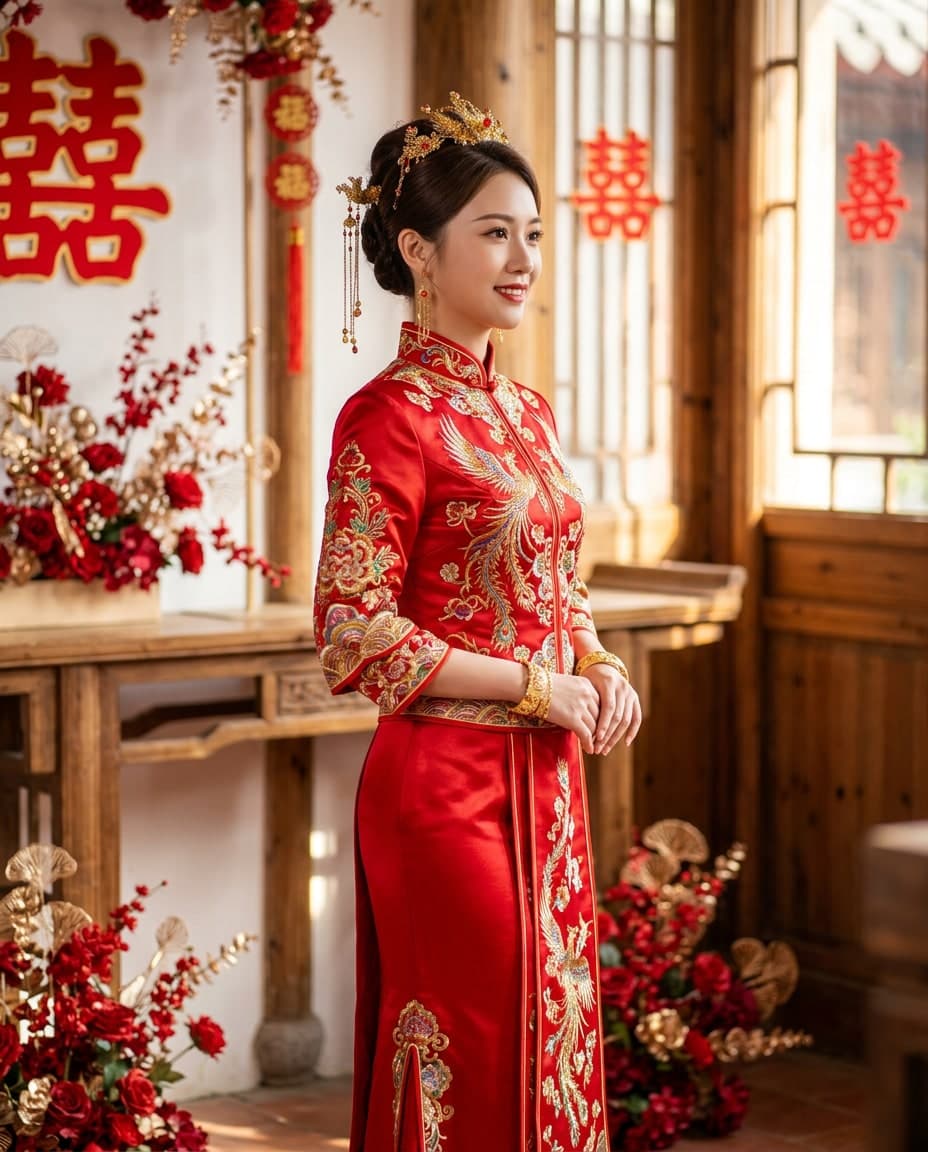
Chinese WeddingNew

Chinese Wedding

High quality, real, HDR, HD, Chinese wedding dresses are usually red because red represents happiness and good luck in Chinese culture. In terms of design, many Chinese brides will choose cheongsam-style wedding dresses. This design can show off the bride’s figure and oriental charm. The material is usually silk or satin

chinese weddingbridecheongsam
Indian StyleNew

Indian Style

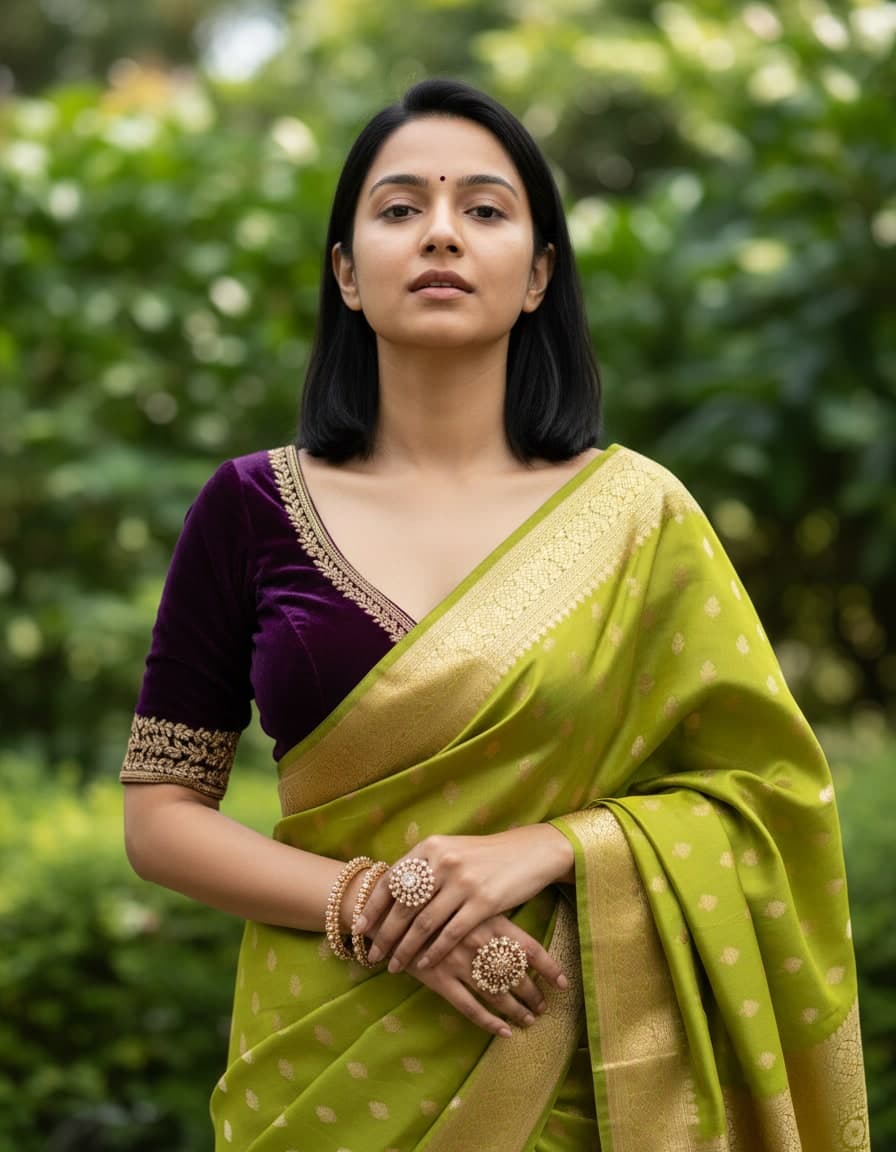
The subject is dressed in a deep violet velvet blouse with a plunging V-neckline and gold-trimmed elbow-length sleeves, draped in a lustrous lime-green silk saree featuring gold woven polka-dot motifs and a detailed gold border. Heavy jewe…

sareeindian fashiontraditional

Tips for Traditional portraits prompts

  • Name specific cultural garments and fabrics, such as muga silk, anarkali robes, or cross-collar hanfu.
  • Specify jewelry types, embroidery patterns, and border threadwork to ensure authentic regional styling.
  • Add authentic architectural backgrounds like palace archways or havelis to anchor ceremonial attire.
Related topics

Frequently asked questions

Can I apply traditional attire to my own uploaded photos?
Yes, many prompts are structured for identity preservation using uploaded portrait references. Specify that facial structure, skin tone, and age remain unchanged while transforming clothing and environment.
Which AI models work best for traditional portraits?
Nano Banana 2.1 and Nano Banana Pro are widely used for rendering intricate textile embroidery, cultural jewelry, and multi-person wedding compositions.
How do I adapt a prompt to a different regional culture?
Replace the regional attire terms, fabric descriptions, and accessory details with the traditional garments and colors specific to your desired culture.