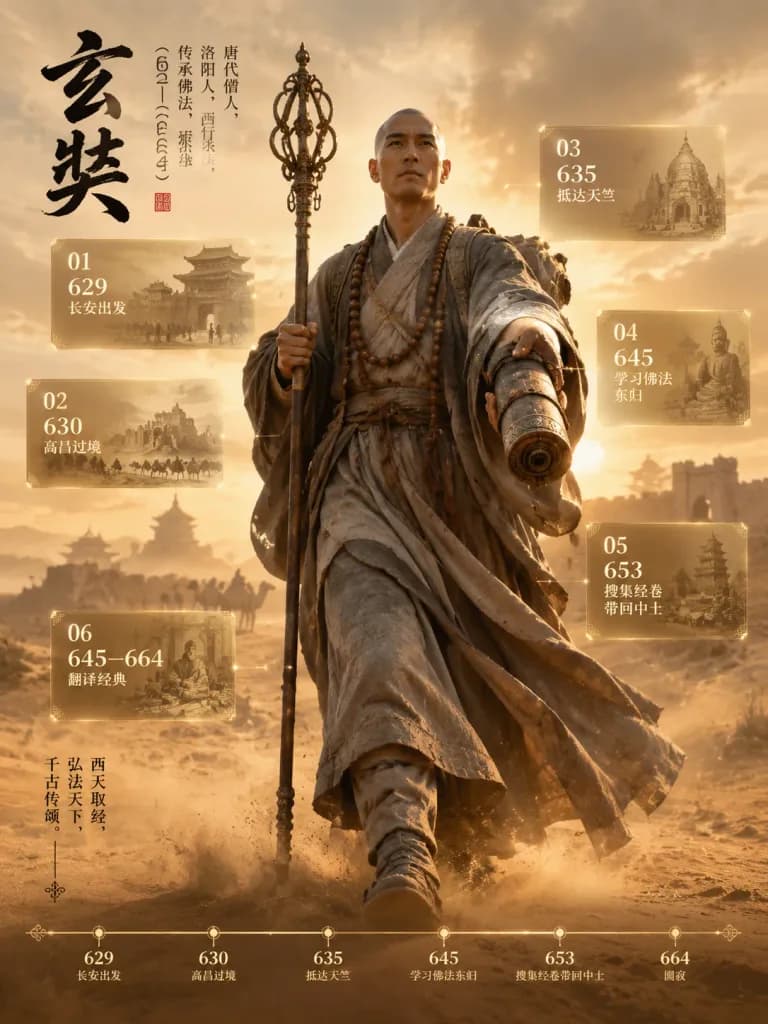
Cinematic vertical historical figure archive poster of [Xuanzang], depicting a Tang dynasty monk as a monumental full-body traveler walking toward the viewer across a desert Silk Road landscape in an epic museum exhibition style with realistic 3D rendering.
Composition and Canvas: Vertical poster in a warm sepia and dusty gold color palette with dramatic backlighting, hazy skies, windblown sand, and silhouettes of ancient pagodas and ruined frontier city walls in the distance. The monk occupies most of the frame height, positioned slightly right of center, walking forward with strong visual depth.
Main Subject: A bald Tang dynasty Buddhist monk wearing weathered, layered gray-brown robes, wrapped sashes, prayer beads around his neck, with dust-stained realistic cloth textures blowing in the wind. In his right hand he carries a tall ornate monk staff, and in his left hand he extends an ancient rolled sutra scroll case toward the viewer, appearing to break the visual frame. His facial features are softly obscured, conveying a solemn, determined, and pioneering aura.
Calligraphy and Typography: At the upper left, bold black ink-brush Chinese calligraphy reads "[玄奘]". Beside it runs delicate vertical Song-style biographical text noting Tang dynasty origins, westward pilgrimage, Buddhist transmission, and dates 602—664, sealed beneath with a small red vermilion stamp. A slim vertical archival route quote runs down the lower left.
Floating Archive Panels: Exactly 6 semi-transparent glass infographic panels with delicate gold borders, subtle node connectors, off-white and gold typography, and faint historical illustration backdrops, numbered in chronological order:
- 01 (upper left): 629, departure from Chang'an
- 02 (mid-left): 630, crossing Gaochang
- 03 (upper right): 635, reaching Tianzhu/India
- 04 (mid-right): 645, studying Buddhism and returning east
- 05 (lower right): 653, collecting and bringing back scriptures
- 06 (lower left): 645—664, translating classics
Bottom Timeline: A sleek horizontal timeline across the bottom with exactly 6 dot markers labeled 629, 630, 635, 645, 653, and 664, accompanied by refined Chinese-style micro captions.
Style: [ultra-realistic 3D historical poster, cinematic lighting, museum archive infographic, sepia desert palette, volumetric dust, high-detail cloth and metal textures]. Elegant, solemn, and heroic historical archival portraiture combined with holographic infographics.
poster storicovia della setainfografica