
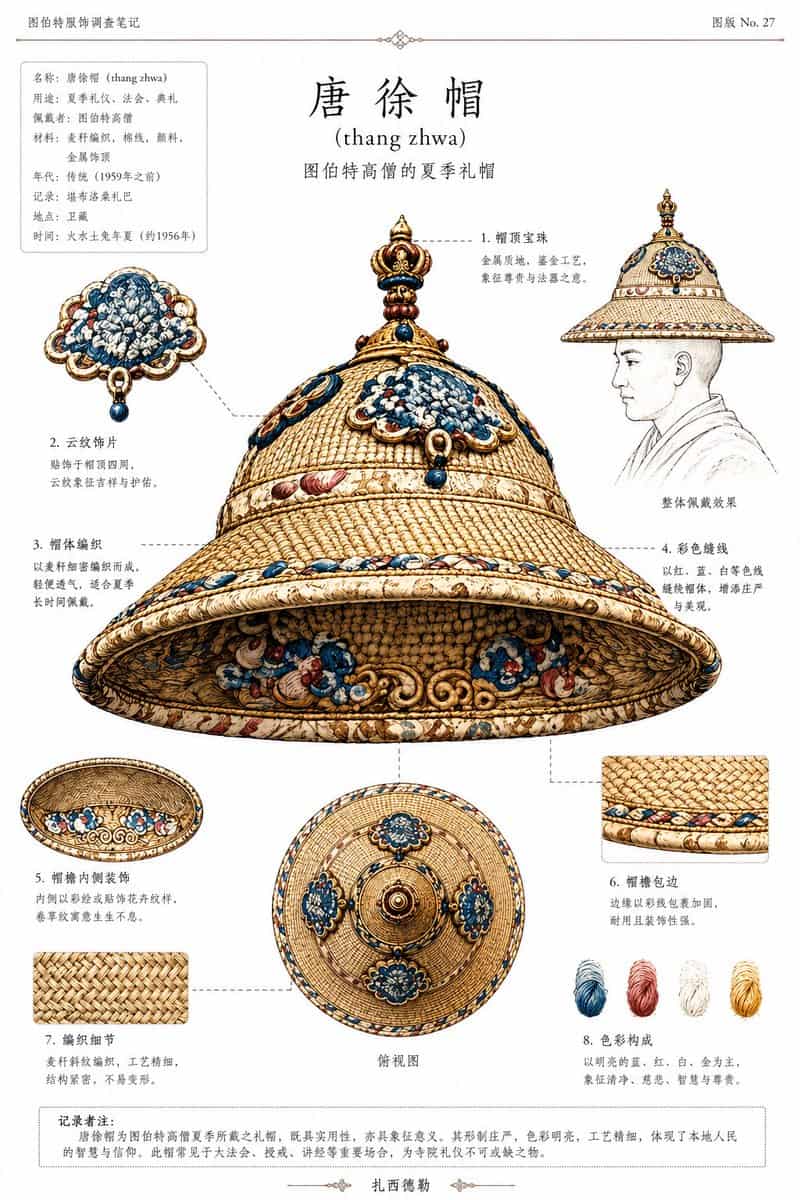
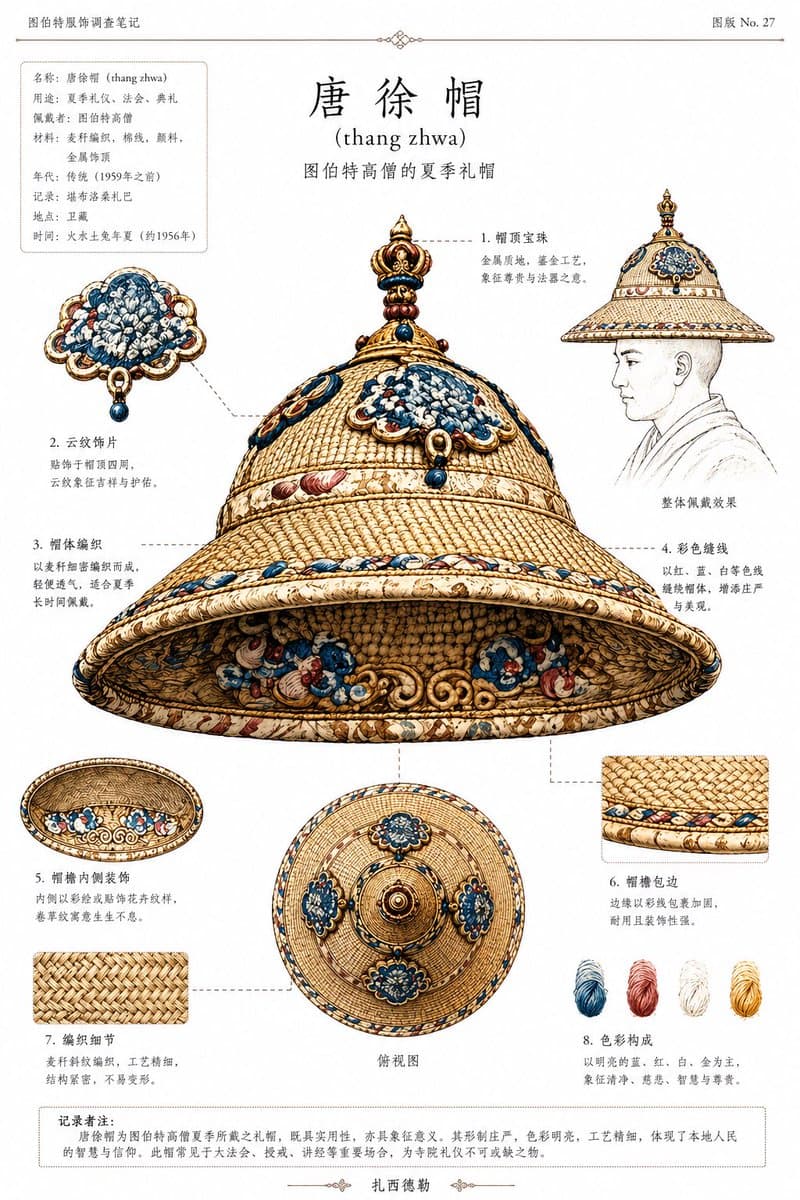
Ethnographic Plate for Tibetan Ceremonial Hat
Using REFERENCE_0 and REFERENCE_1, create a clean ethnographic archive plate focused on the ceremonial hat. Use REFERENCE_0 as the historical Tibetan context and silhouette reference, and REFERENCE_1 as the color, mater…
提示詞
Using REFERENCE_0 and REFERENCE_1, create a clean ethnographic archive plate focused on the ceremonial hat. Use REFERENCE_0 as the historical Tibetan context and silhouette reference, and REFERENCE_1 as the color, material, and ornament reference for the hat. Isolate and reconstruct the hat as a museum-style object study, removing the seated body as the main subject. Present the hat on an off-white document page as a scholarly catalog sheet in Chinese with small romanization. Add 8 numbered callouts around the object with fine dashed leader lines, each pointing to a specific structural detail. The centerpiece should be one large three-quarter underside view of the hat. Also include exactly 4 supplementary views/details: 1 side-profile wearing sketch with a faint line-drawn bust, 1 underside interior view, 1 top-down view, and 2 square close-up material swatches. Add exactly 4 thread-color samples near the lower right: blue, red, white, and yellow. At the top center, add the large title {argument name="headline text" default="唐徐帽"} with the romanization {argument name="romanization" default="(thang zhwa)"} beneath it, plus a smaller subtitle describing it as a summer ceremonial hat of high-ranking Tibetan monks. In the upper left, add a boxed metadata panel with multiple short Chinese fields, and in the upper right add a plate number reading {argument name="plate number" default="图版 No. 27"}. At the bottom, add one bordered note paragraph in Chinese. Overall style: meticulous archival infographic, anthropological catalog illustration, historically informed, precise woven texture, ivory-gold base with blue and red ornament, elegant print layout, thin rules and decorative divider marks, high-detail object rendering on a plain paper background.
如何使用此提示
在生成之前閱讀完整的 Ethnographic Plate for Tibetan Ceremonial Hat 提示並確定主題、風格、相機、燈光和構圖要求。
將括號或參數式佔位符替換為您的產品、角色、品牌、場景、調色板或寬高比要求。
開啟 https://www.gptimagehub.com/zh-TW/generate?promptId=cmogx1q4s00cdzpdy98napsnv,產生圖像,然後根據需要使用更具體的主題、文字、佈局或負面約束來最佳化提示。
提示常見問題解答
Ethnographic Plate for Tibetan Ceremonial Hat 提示符號最適合用來做什麼?
此提示最適用於您需要可重複使用結構、詳細視覺方向和一致輸出品質的 logo 與品牌 影像。
我可以在生成之前編輯提示嗎?
是的。完整的提示文字在此頁面上可見,因此您可以在生成之前更改主題、產品名稱、顏色、構圖、相機術語、長寬比和樣式註釋。
出現此提示時我應該使用哪種型號?
使用提示元資料中顯示的模型作為預設起點。如果另一個影像模型支援相同的寬高比和指令風格,您可以調整提示並比較結果。